
Wonder Woman of the Week: Telesilla of Argos
History often remembers the generals and kings (or in this blog’s case queens) of great wars, but the everyday soldier is often forgotten. This week’s spotlight is one of the rare general infantry from history whose name is still on the record as worth remembering. She was a poet, an orator, and a soldier who stood beside the men of her nation during a time of invasion and inspired her people to win the war. The Wonder Woman of the Week is Telesilla of Argos.
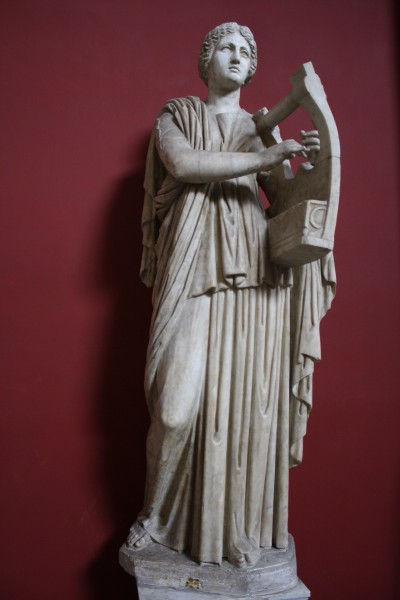
For the most part, primary sources on Telesilla are few and most give only a sentence about the warrior poet who helped defend her nation from foreign invasion. Maximus of Tyre wrote “The Spartiates were roused by the poems of Tyrtaeus, the Argives by the songs of Telesilla, and the Lesbians by the poetry of Alcaeus.” Telesilla was also mentioned in Antipater’s list of the Nine Women of Lyric Poets which liked real-life women in Antiquity with the Nine Muses of Greek Mythology. Perhaps the most descriptive account of Telesilla comes from Pausanias who describes a theatre in Argos with a statue commemorated to Telesilla. Pausanias recounts the tale of Sparta’s invasion of Argos when all fighting men were either killed in battle or burned to death after surrendering. Telesilla responded by organizing an army of Argos’ women and fighting one last battle against the Spartans. The courage of the women convinced the Spartans to call a truce and left Argos in peace.
Together with secondary sources produced by modern historians, the story of Telesilla’s life becomes a bit more complete. Telesilla was a lyric poet during the 5th Century BCE and even invented her own form of lyric poetry known as the Telesillean Metre. Telesilla was ill for most of her childhood, so she spent the majority of her time studying poetry and writing. She gained great fame for her work- which is all lost to history except for two lines quoted by Hephaistion of Alexandria in his Handbook on Meter. [2]
Her secondary fame came from her military success in 494/493 BCE. While writing epic poetry in Argos, the city came under siege by the Spartan hoplites. The Spartan king Cleomenes I massacred Argos’ men outside the city, then burned the men who came to negotiate its surrender. In response, Telesilla organized the remaining townspeople- women, children, and elders- to make a last stand in defense of their city. Plutarch himself wrote that there was no case in Greek history in which women fought in battle more famous than in Telesilla’s defense of Argos. The women of the city inflicted such casualties upon the Spartans, that King Cleomenes I agreed to abandon the siege and returned to Sparta. [2]
In response to the victory, Argos held a festival every year in which women dressed in men’s clothes and men dressed as women on a holiday called Hybridiska or “Festival of Impudence.” The women who died in battle were given full military funerals, and a temple to Ares Enyalius was built in honor of the women who survived the battle- including Telesilla. [3]
The lyrical works of songwriter Telesilla have long since been lost to history- but the respect of her colleagues remains on the books. Not only a writer, Telesilla also served as a volunteer soldier, helping to defend a city in need. She organized an army of women who threw back an invasion force of the greatest warriors of their time. Telesilla survived the battle and continued her work as a lyricist. The real-life Muse of song (as Antipater himself named her) was a writer and an army veteran. She’s one of a few GI’s remembered by name in history and even though her art has been long lost, her story remained.
Edmonds, JM. “Lyra Graeca II.” 1924. pp 236-245. CSUN.edu. Accessed 30 March 2016. http://www.csun.edu/~hcfll004/telesilla.html
Mark, Joshua J. “Telesilla of Argos.” 25 March 2014. Ancient.eu. Accessed 30 March 2016. http://www.ancient.eu/Telesilla_of_Argos/
Plutarch. “On the Bravery of Women.” 2nd Century CE. Women’s Life in Greece and Rome. Accessed 30 March 2016. http://www.stoa.org/diotima/anthology/wlgr/wlgr-publiclife160.shtml


Comments