
Wonder Woman of the Queen: Queen Thyra

Long before Denmark became the modern Scandinavian nation known today, its lands were divided among communities, chieftains, and competing kingdoms. Into this world, probably in the early 10th century, came Thyra, a woman whose life is remembered through a handful of inscriptions and later traditions. Much about her origins remains uncertain. Medieval sources offer different accounts of her family, and historians cannot reconstruct her childhood with confidence. Yet by the middle of the 900s, Thyra had become the wife of Gorm the Old, the ruler traditionally regarded as Denmark’s first historically attested king. Her story survives at the intersection of archaeology, royal legend, and one of Scandinavia’s most remarkable collections of Viking Age runestones.
Thyra’s early life probably unfolded within the aristocratic world of Viking Age Scandinavia, where political power depended heavily on family alliances. Later medieval writers attempted to give her a distinguished ancestry, but these accounts were written generations after her lifetime and cannot all be accepted as historical fact. What is clearer is that Thyra eventually occupied a position at the heart of Denmark’s emerging monarchy. Her marriage to Gorm was more than a personal union. In an age when marriage could connect territories, families, and political interests, a queen could help create relationships that strengthened a ruler’s authority. Thyra therefore belonged to a generation living through the transformation of Denmark from a collection of regional powers into a more unified kingdom.
Gorm, known to history as Gorm the Old, ruled during the first half of the 10th century. Sources portray him as a powerful king, although the boundaries of his kingdom remain difficult to define. Thyra stood beside him during a period when Denmark faced pressures from neighboring peoples and competing Scandinavian rulers. Later tradition particularly associates her with the defense and strengthening of the Danish realm. Some accounts credit her with organizing or strengthening fortifications known as the Danevirke, the great defensive system stretching across the base of the Jutland Peninsula. Archaeology shows that the Danevirke developed over centuries, however, so it would be misleading to describe Thyra as its sole builder. Her traditional association with the defenses nevertheless reflects the memory of a queen regarded as an important protector of Denmark.
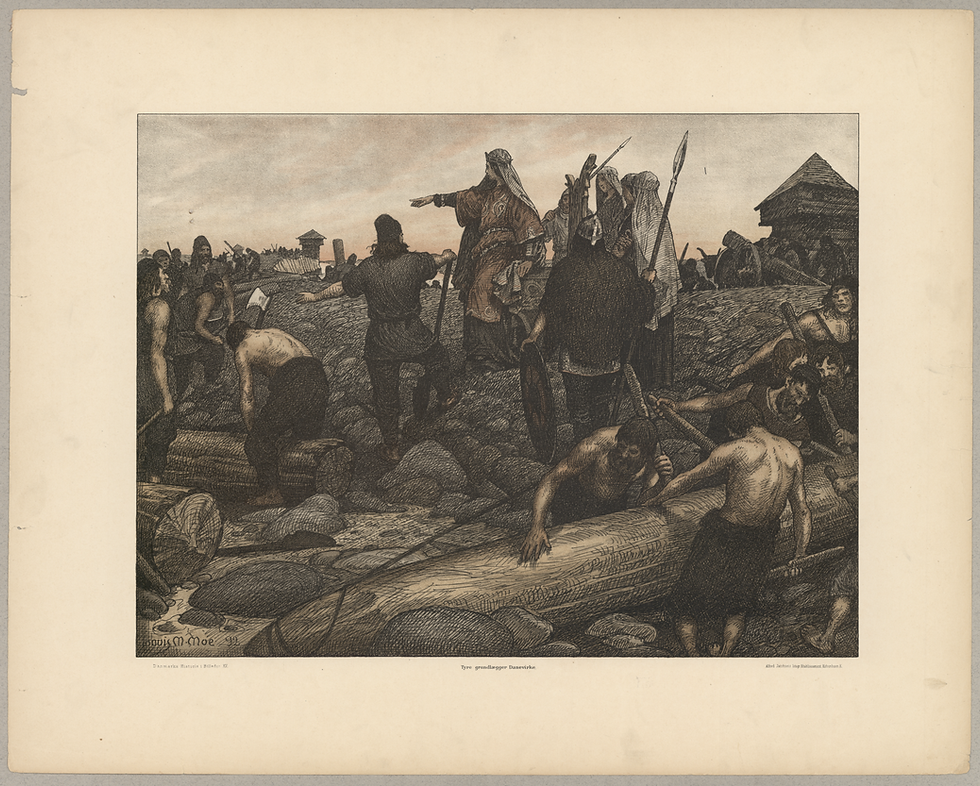
Descriptions of Thyra as exceptionally wise also come largely through later tradition rather than contemporary records. Medieval stories portray her as intelligent, politically capable, and influential in matters affecting the kingdom. Such stories should be approached carefully, but they reveal something important about how later generations remembered her. Thyra was not simply presented as a king’s wife standing quietly behind the throne. Instead, she became associated with foresight, leadership, and the preservation of the kingdom. Whether every story about her is historically accurate or not, the persistence of these traditions suggests that her reputation for wisdom became an important part of Denmark’s royal memory.
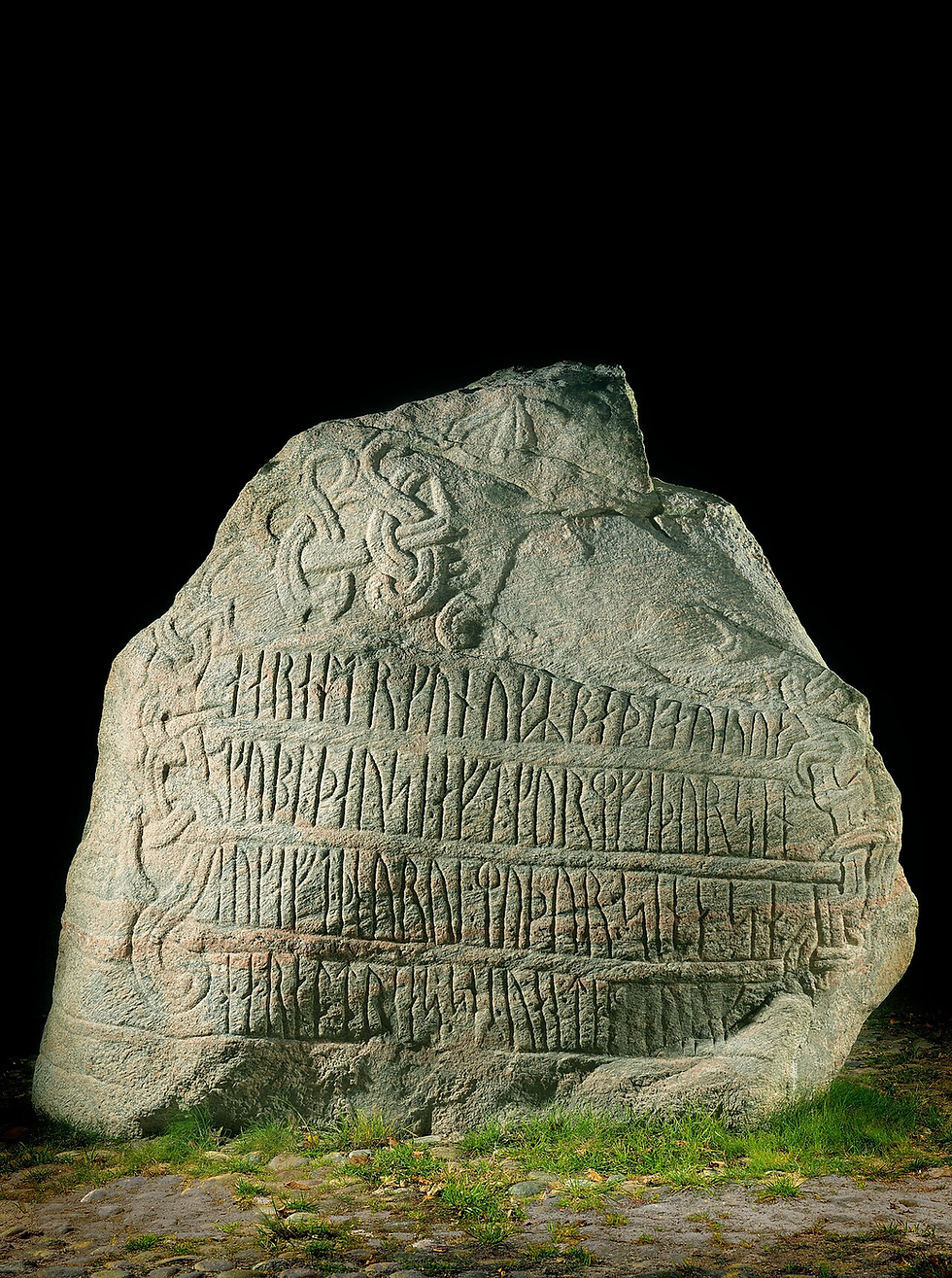
The strongest evidence for Thyra comes from the stones erected at Jelling in Jutland. These enormous monuments, created during the Viking Age, stand among Denmark’s most important archaeological treasures. One runestone was raised by Gorm in memory of Thyra. Its inscription identifies her as his wife and calls her Danmarks bod, a phrase commonly translated as “Denmark’s adornment” or “Denmark’s pride.” The words are extraordinary because they place Thyra directly within the public story of the kingdom. Her name was carved into stone alongside her husband’s, ensuring that her identity would survive long after their generation had disappeared.
Another and even larger Jelling stone was raised by their son, Harald Bluetooth. Harald’s inscription famously declares that he won all Denmark and Norway and Christianized the Danes. Yet before announcing these achievements, Harald identifies himself as the son of Gorm and Thyra. The monument therefore presents the royal family as a chain of generations: Gorm, Thyra, and Harald. Archaeologists have also discovered other inscriptions and monuments connected with the Jelling complex, while runestones elsewhere in Scandinavia preserve the names and memories of people from this period. Together, these stones demonstrate how Viking Age rulers used writing, monuments, and public landscapes to establish ancestry and political legitimacy.
Thyra’s death probably occurred in the mid-10th century, although the exact date remains uncertain. Her burial has also generated debate. The Jelling monuments include a large burial mound traditionally associated with Gorm and Thyra, and excavations have revealed evidence of an impressive royal burial landscape. Human remains found in the Jelling complex have raised questions about how Gorm and Thyra were buried and later moved, particularly after Harald’s Christianization of Denmark. The evidence does not provide a simple biography carved into stone, but it does show that Thyra occupied a place within an extraordinary royal landscape where pagan traditions, emerging Christianity, and the ambitions of a new Danish monarchy met.
More than a thousand years later, Thyra’s name remains unusually powerful precisely because so little is known about her ordinary life. She left no surviving writings, and there is no detailed contemporary biography describing her thoughts, childhood, or daily responsibilities. Yet her name endured because people deliberately placed it in monumental inscriptions. Those few words have allowed her to emerge from the shadows of Viking Age history. They remind us that women could participate in the political life of early kingdoms even when surviving historical records were overwhelmingly created by men. Thyra’s story also encourages historians to look beyond battles and kings to the family relationships, alliances, and cultural traditions that helped hold societies together.
For young women and girls today, Queen Thyra can serve as a compelling historical role model—not because every later legend about her should be accepted as fact, but because her memory challenges the assumption that powerful women were absent from the Viking Age. Her name survives beside those of kings, carved into monuments intended to outlast generations. Remembered as a wife, queen, protector, and figure of wisdom, Thyra represents the many women whose influence may have been greater than surviving records reveal. Her story invites a broader understanding of leadership: strength can be expressed through diplomacy, intelligence, perseverance, family, and service to a community. Across the centuries, the stones of Jelling continue to whisper her name, reminding us that Denmark’s early history was shaped not only by its kings, but also by the women who stood beside them.


Comments