
The Olmecs: Mothers of Civilization
If we could go back in time to an era long enshroud in mystery to a culture whose long-lasting ruins create more questions than answers, of stone heads that reveal more riddles than clues, and whose people have left little evidence behind of their daily lives; what would we learn? What questions could we answer? What insight would we gain about the origins of civilization in the Americas? The Olmecs were one of the earliest and most influential civilizations in Mesoamerica, flourishing from around 1500 BCE to 400 BCE in the tropical lowlands along the Gulf Coast of present-day Mexico, primarily in the modern states of Veracruz and Tabasco. Often referred to as the “mother culture” of Mesoamerica, the Olmecs laid many of the cultural and religious foundations that influenced later civilizations like the Maya and Aztecs.
Olmec society was highly organized, with complex religious beliefs, stratified social structures, and impressive urban centers such as San Lorenzo, La Venta, and Tres Zapotes. These cities featured large ceremonial platforms, pyramids, and massive stone structures. The Olmecs are perhaps best known for their colossal stone heads—up to 10 feet tall and weighing several tons—carved from basalt and believed to represent rulers or important individuals. Religion played a central role in Olmec life, with gods often represented as part human and part animal, such as the jaguar, a prominent spiritual symbol. They practiced rituals involving bloodletting and possibly early forms of human sacrifice. The Olmecs also developed one of the earliest known Mesoamerican writing systems and a calendar system, although both remain only partially understood today.
Economically, the Olmecs engaged in extensive trade, exchanging goods such as obsidian, jade, rubber, and ceramics with distant regions. This trade helped spread Olmec influence across Mesoamerica. Their art, architecture, and religious iconography left a lasting impact on subsequent cultures. By around 400 BCE, major Olmec centers declined, likely due to environmental changes, internal conflict, or shifting trade routes. Despite their decline, the Olmec legacy endured through the civilizations that followed, making them a cornerstone of ancient Mesoamerican history.
The origins of the Olmec civilization remain a subject of scholarly investigation, but most evidence points to their emergence in the tropical lowlands of the Gulf Coast of present-day southern Mexico, particularly in the modern states of Veracruz and Tabasco, around 1600–1500 BCE. This region’s fertile river valleys, abundant rainfall, and rich natural resources—such as rubber, cacao, and clay—provided an ideal environment for early complex societies to develop. The Olmecs likely evolved from earlier farming communities in the region. Archaeological findings suggest that maize agriculture played a crucial role in supporting growing populations and the development of permanent settlements. These early societies began to form complex social and political structures, giving rise to the Olmec civilization. San Lorenzo, one of the earliest major Olmec centers, rose to prominence around 1200 BCE, showcasing advanced urban planning, monumental architecture, and intricate artistry.

Cultural innovations, such as religious rituals, iconography, and monumental sculpture, appear to have developed locally, although some scholars propose limited external influences from other early civilizations in Central America. Still, most evidence supports the Olmecs as a homegrown culture that achieved a high level of sophistication independently. Their colossal stone heads, ceremonial centers, and early writing and calendrical systems indicate a civilization with centralized authority, specialized labor, and deep religious traditions. The origins of Olmec political authority likely rested on the combination of religious ideology and elite control over resources and trade networks. Their influence expanded far beyond their heartland through trade and cultural diffusion, setting the stage for future Mesoamerican civilizations.
La Venta was one of the most important and influential Olmec ceremonial centers, flourishing between approximately 900 BCE and 400 BCE. Located in present-day Tabasco, Mexico, near the Gulf Coast, La Venta succeeded San Lorenzo as the primary Olmec political and religious hub after San Lorenzo’s decline. Its strategic location in a fertile, swampy area allowed access to trade routes and abundant natural resources, which helped support its growth and influence.
La Venta is best known for its sophisticated urban layout and monumental architecture. At the heart of the site lies the Great Pyramid, a massive earthen mound rising about 100 feet, believed to be the largest structure of its kind in Mesoamerica at the time. The pyramid likely served religious and ceremonial purposes, symbolizing sacred mountains and possibly functioning as a platform for elite rituals. The site also features a large plaza, altars, and numerous stone monuments, including four of the famous Olmec colossal heads. These basalt heads, carved with distinctive facial features and helmet-like headgear, are thought to represent rulers or revered individuals. Additionally, La Venta is notable for its buried offerings—ceremonial deposits of jade, serpentine, and other precious materials arranged in symbolic patterns, reflecting complex religious beliefs and elite power.

La Venta played a central role in spreading Olmec influence across Mesoamerica through trade, ideology, and art. Its distinctive style of iconography, especially motifs involving jaguars and supernatural beings, had a lasting impact on later cultures such as the Maya and Zapotec. By around 400 BCE, La Venta was abandoned, possibly due to environmental changes, internal conflict, or shifting political dynamics. Despite its decline, the site remains a key archaeological source for understanding Olmec society and its foundational role in Mesoamerican civilization.
The decline of the Olmec civilization occurred around 400 BCE, marking the end of one of Mesoamerica’s earliest and most influential cultures. While the exact causes remain uncertain, scholars believe the collapse was likely the result of a combination of environmental, political, and economic factors rather than a single catastrophic event. Environmental changes may have played a major role. The Olmec heartland, located in the lowland tropics of modern-day Veracruz and Tabasco, was vulnerable to flooding, shifting river patterns, and possibly even volcanic activity. Such disruptions could have damaged farmlands, altered trade routes, and forced populations to abandon key centers like San Lorenzo and La Venta. Deforestation and soil exhaustion due to intensive agriculture may have also contributed to a gradual ecological decline.
Political upheaval and internal conflict may have further destabilized Olmec society. Evidence suggests that San Lorenzo, the first major Olmec center, experienced sudden destruction around 900 BCE, possibly the result of revolt or invasion. As elite power weakened or shifted, rival groups may have competed for control, leading to fragmentation and social unrest. The later abandonment of La Venta around 400 BCE could reflect similar internal tensions.

Additionally, changing trade networks likely influenced the Olmec decline. The Olmecs depended on long-distance exchange for luxury goods like jade, obsidian, and basalt. If trade routes shifted or external partners lost influence, the economic foundation of Olmec society may have eroded, weakening elite authority. Although the civilization declined, its cultural legacy endured. Olmec religious symbols, artistic styles, and urban planning deeply influenced later Mesoamerican societies such as the Maya, Zapotec, and Aztec.

The material culture of the Olmecs reveals a highly developed society known for its artistry, craftsmanship, and symbolic complexity. Flourishing between 1500 BCE and 400 BCE in the Gulf Coast region of present-day Mexico, the Olmecs produced a wide range of artifacts from materials such as stone, clay, jade, and ceramic, reflecting their religious beliefs, social hierarchy, and interactions with the environment. One of the most iconic elements of Olmec material culture is the colossal stone heads, carved from basalt and weighing up to 40 tons. These sculptures, believed to represent rulers or important figures, showcase advanced skill in quarrying, transport, and carving. Each head is unique, often featuring helmet-like headgear, suggesting links to warfare or ritual ballgames.
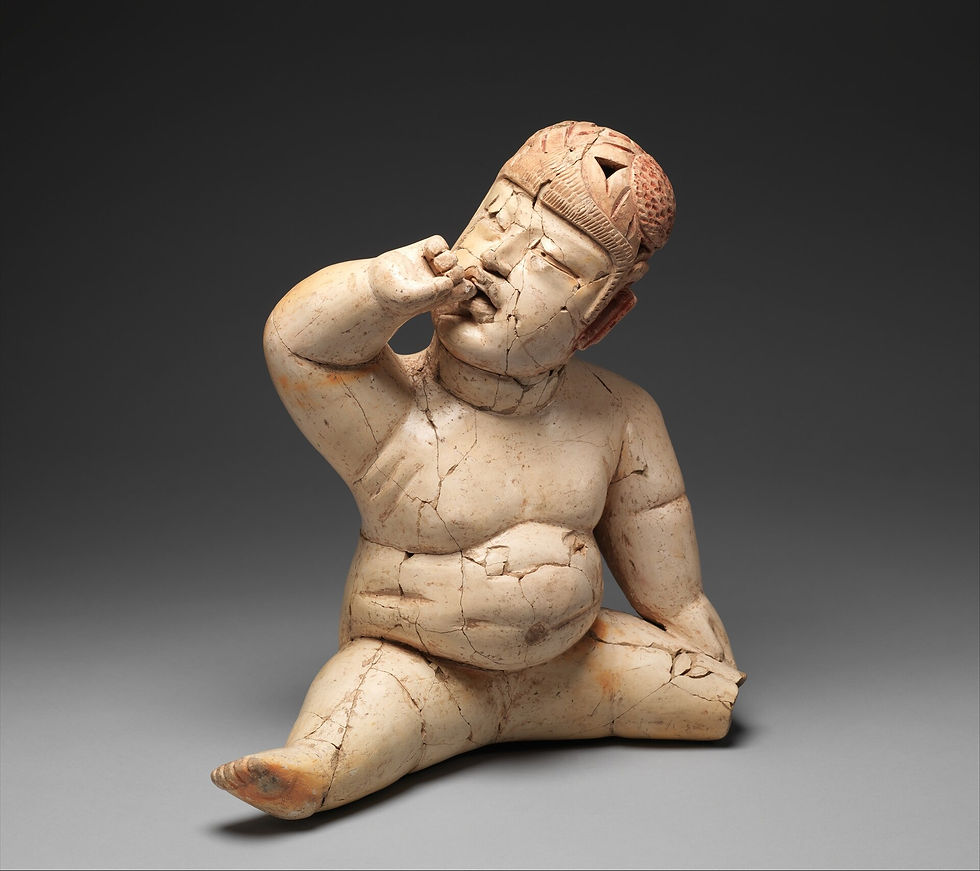
Jade was another prized material, associated with fertility, the divine, and elite status. Olmec artisans carved jade into figurines, masks, pendants, and celts (ceremonial axes), often depicting supernatural beings or shamanic transformations. The difficulty of working jade and its distant sources highlight the Olmecs’ long-distance trade connections and their dedication to ritual objects. Clay and ceramic artifacts were common in everyday life as well as religious contexts. Pottery ranged from utilitarian vessels to intricately decorated figurines representing deities, animals, and humans. Many of these figures exhibit traits such as downturned mouths and almond-shaped eyes, now considered part of the distinctive “Olmec style.”
The Olmecs also built monumental architecture—earthen mounds, plazas, and platforms—using tools made from stone and wood. These structures formed ceremonial complexes aligned with astronomical and cosmological principles, reflecting a deep connection between architecture and belief. Together, these materials and objects offer insight into Olmec society, from elite power and religious practice to artistic innovation and regional influence. Their material culture laid the foundation for many traditions seen in later Mesoamerican civilizations.

While the Olmec heartland was located along the Gulf Coast in the modern-day Mexican states of Veracruz and Tabasco, their cultural influence extended into Central Mexico, playing a foundational role in the development of later Mesoamerican civilizations. Though there is no evidence of large-scale Olmec settlements in Central Mexico itself, artifacts and stylistic elements found at key sites suggest strong interaction through trade, cultural diffusion, and possibly religious influence.
One of the primary ways the Olmecs impacted Central Mexico was through the spread of their artistic and symbolic styles. Artifacts such as jade masks, figurines, and carved stone objects bearing Olmec iconography—jaguar motifs, infant-like faces, and cleft-headed figures—have been discovered at highland sites like Tlatilco, Chalcatzingo, and Teopantecuanitlan. These suggest that elite groups in these regions adopted Olmec symbols to express authority, religious legitimacy, or connection to powerful Gulf Coast networks.
Chalcatzingo, in particular, located in modern-day Morelos, provides strong evidence of Olmec influence. Monumental reliefs carved into rock outcrops depict figures in Olmec-style dress and posture, some possibly representing shamans or rulers. These artworks indicate not only the presence of Olmec cultural ideas but also local interpretations and adaptations of them. Trade was likely the main conduit for Olmec influence into Central Mexico. Goods such as jade, obsidian, rubber, and ceramics moved along exchange routes that connected diverse regions. Through this exchange, Central Mexican communities came into contact with Olmec religious concepts, artistic styles, and possibly social organization models.

The presence and influence of the Olmecs in western Mexico is less direct than in regions closer to their Gulf Coast heartland, but archaeological evidence suggests that contact and cultural exchange did occur. Western Mexico—encompassing present-day states like Jalisco, Colima, Nayarit, and Michoacán—was home to distinct cultures during the Olmec period (1500–400 BCE), including the Capacha and later Chupícuaro traditions. While these societies developed independently, evidence indicates they were not isolated from broader Mesoamerican currents.
Traces of Olmec-style artifacts have been found at several western Mexican sites, including jade objects, ceramics, and figurines exhibiting iconographic features associated with the Olmec “style”—such as almond-shaped eyes, cleft heads, and baby-like figures. These items suggest that western Mexican elites may have adopted or adapted Olmec symbols to enhance their own social or religious authority. However, such influences were typically filtered through local traditions and were not exact replicas of Gulf Coast Olmec forms.
The most likely vector for Olmec influence in western Mexico was long-distance trade. The Olmecs were part of a vast network that exchanged goods such as obsidian, shell, jade, and ceramics. Western Mexico, in particular, was a major source of obsidian—a valuable volcanic glass used for tools and ritual items—which could have facilitated contact with the Gulf Coast. Despite these connections, western Mexico maintained a unique cultural trajectory. Its shaft tomb tradition, distinctive ceramic styles, and burial practices differ markedly from those of the Olmec heartland. This suggests that while Olmec ideas may have influenced western Mexican societies, they were selectively integrated into a broader, regionally distinct cultural context.

The Olmecs extended their cultural influence into southern Mexico and parts of Guatemala through trade, symbolic diffusion, and shared religious practices. While the Olmec heartland was centered in the Gulf Coast region, their impact reached deep into the southern highlands and Pacific coast, particularly in areas such as Chiapas, Oaxaca, and the Pacific lowlands of Guatemala. Key archaeological sites in this region show clear evidence of Olmec interaction. One of the most significant is Takalik Abaj, located in modern-day Guatemala. This site contains a mix of Olmec-style and later Maya elements, suggesting it was a cultural crossroads. Monumental stone sculptures at Takalik Abaj display classic Olmec traits, including jaguar imagery, downturned mouths, and elaborate headdresses. These features reflect either the presence of Olmec artisans or strong ideological influence from the Gulf Coast.

In Chiapas, the site of Abaj Takalik and Chiapa de Corzo show similar Olmec-inspired elements, including pottery styles and religious iconography. These sites likely served as important trade centers or regional hubs where Olmec religious and political ideas merged with local traditions. Oaxaca, particularly the Valley of Oaxaca and sites like San José Mogote, also show early Olmec influence, especially in ceramics and elite symbols. While the Zapotec civilization eventually emerged in this region with its own distinct identity, its early development was likely shaped in part by Olmec models of rulership and ceremonial architecture. In all these regions, the Olmec influence was likely transmitted through long-distance trade, elite emulation, and shared ceremonial practices, rather than conquest or colonization. Local cultures adopted and adapted Olmec symbols to fit their own social and political needs.
Bloodletting and potentially human sacrifice played significant roles in Olmec religious and ceremonial life, reflecting their complex spiritual beliefs and the importance of maintaining cosmic balance. As one of Mesoamerica’s earliest civilizations, the Olmecs helped establish ritual practices that would influence later cultures like the Maya and Aztec, both of which viewed blood as a powerful offering to the gods.
Bloodletting—the ritual shedding of blood, often by piercing or cutting parts of the body—was likely practiced by the Olmec elite, particularly rulers and priests. This act was seen as a form of communication with the supernatural realm and a way to ensure fertility, rain, and agricultural success. Although direct evidence is limited due to the perishable nature of blood and soft tissues, Olmec art and iconography support the presence of such practices. Carvings and figurines depict individuals holding blades or positioned in postures associated with self-sacrifice, suggesting the symbolic importance of bloodletting in elite rituals.

The possibility of human sacrifice among the Olmecs remains debated, as concrete archaeological evidence is sparse compared to later Mesoamerican societies. However, some scholars point to buried offerings at major Olmec sites like La Venta and San Lorenzo, which include dismembered human remains, suggesting ritual killings may have occurred. These remains are sometimes found alongside high-value items like jade and serpentine, indicating the ceremonies had deep religious and political significance. If practiced, human sacrifice likely served to reinforce social hierarchies and divine kingship, with victims possibly seen as offerings to appease gods or ancestors. While not as overtly documented as in later cultures, these practices hint at a broader Olmec worldview centered on cyclical renewal, divine power, and the sacred role of blood.
The Olmec writing system remains one of the most enigmatic aspects of their civilization, and while definitive conclusions have yet to be reached, evidence suggests that the Olmecs developed some form of early writing or symbolic communication. The Olmecs are often credited with laying the groundwork for the later Mesoamerican writing systems, such as those of the Maya and Zapotecs. The most compelling evidence for Olmec writing comes from a series of stone carvings, particularly the San Andrés and La Venta monuments, which feature symbols or glyphs that appear to represent words or concepts. These glyphs are found in clusters, suggesting that they may have been part of a larger system used for inscription or ceremonial purposes. One of the most famous potential examples of Olmec writing is the "Cascajal Block", a large stone slab discovered in Veracruz in 1999. The block features a series of 62 symbols that some researchers believe may constitute an early form of writing. While its exact meaning is still debated, the block has been dated to around 900 BCE, which predates the earliest known Maya script by several centuries.
The Olmec writing system, if it existed, appears to have been primarily ideographic, meaning that the symbols likely represented ideas or concepts rather than sounds, much like other early Mesoamerican scripts. Some researchers have proposed that the Olmecs used writing for religious or political purposes, recording important events or royal decrees. Though the Olmec writing system remains only partially understood, it is clear that they were engaged in the development of symbolic communication that influenced later Mesoamerican cultures. The legacy of Olmec writing, whether fully deciphered or not, is foundational to the complex writing traditions that would emerge in the region.

The Olmec calendar is another area of intrigue in the study of this ancient civilization, though its full complexity remains elusive. The Olmecs are believed to have developed a calendar system that influenced later Mesoamerican cultures, including the Maya, who are famous for their advanced calendrical knowledge. The Olmec calendar was likely based on the tonalpohualli, a 260-day ritual calendar that consisted of 13 cycles of 20 days. This calendar was used for divination and religious purposes, closely tied to the Olmecs' worldview, where cycles of time were seen as influencing agricultural practices, celestial events, and human life. The 260-day calendar is a feature of many Mesoamerican cultures, suggesting its deep roots in the region's cosmological and ritualistic beliefs.
In addition to the tonalpohualli, the Olmecs may have also used a 365-day solar calendar, which was essential for tracking agricultural seasons. This calendar, similar to the one later refined by the Maya, helped mark the solar year and was crucial for timing the planting and harvesting of crops. The use of both calendars—the sacred 260-day and the solar 365-day—would have allowed the Olmec to synchronize their religious observances with the seasons, ensuring that agricultural and ceremonial activities were aligned with cosmic events.
Evidence for the Olmec calendar system is somewhat indirect, as no comprehensive Olmec calendrical inscriptions have been definitively deciphered. However, certain monuments and stelae, like those found at La Venta, show indications that the Olmecs were tracking dates and events in a manner similar to later Mesoamerican cultures. This suggests that the Olmec calendar system was integral to their religious, agricultural, and social organization. Though much of the Olmec calendar remains speculative, its influence on later Mesoamerican cultures underscores the Olmec's role in laying the groundwork for complex timekeeping systems in the region.
Sports and physical activities were an important part of Olmec culture, with evidence suggesting that ballgames played a significant role in their society. The Olmecs are often credited with the earliest development of the Mesoamerican ballgame, a sport that would become a central feature of later Mesoamerican civilizations such as the Maya, Zapotecs, and Aztecs. The ballgame, known as ulama or tlachtli in later cultures, involved teams trying to keep a rubber ball in motion, using their hips, forearms, and other parts of the body to hit the ball through stone rings or against walls. While the specifics of the Olmec version of the game remain unclear, it is believed to have been a ceremonial and symbolic activity, rather than just a recreational one. The ballgame often had deep religious and cosmological significance, representing the struggle between life and death, and was associated with the gods.

At Olmec centers like San Lorenzo and La Venta, evidence of ballcourt structures—long, narrow fields with sloped walls—suggests that the game was played in formalized arenas. These ballcourts, with their symbolic importance, were often situated near major religious and ceremonial areas, highlighting the sacred role of the sport. The Olmecs may have also used the ballgame to reinforce political power and social hierarchies. Rulers or elite individuals likely participated in or sponsored games as a demonstration of power, with possible ties to ritual or sacrifice. While the extent of human sacrifice in relation to the ballgame among the Olmecs is debated, later cultures, like the Maya and Aztecs, often linked the game to bloodletting or sacrificial rites.
The language of the Olmecs remains largely unknown, as there are no surviving written records that provide clear evidence of their spoken or written language. However, scholars have speculated about the nature of Olmec language based on indirect evidence, such as the symbolic use of glyphs, their influence on later Mesoamerican writing systems, and linguistic studies of regional languages. The Olmecs are often credited with being the first Mesoamerican civilization to develop a form of writing, though the extent of this system is still debated. The Olmecs likely used a form of pictographic writing, composed of symbols or glyphs representing ideas or concepts rather than phonetic sounds. These glyphs were likely used in religious and ceremonial contexts to convey important events, rituals, or political decrees.
One of the most significant pieces of evidence for the Olmec language comes from the Cascajal Block, a stone tablet discovered in Veracruz in 1999. The block features a series of 62 symbols, which some researchers believe may represent an early form of writing. While the meaning of the symbols is still unconfirmed, the block is dated to around 900 BCE, which predates the earliest known Maya script by several centuries. This suggests that the Olmecs may have been experimenting with writing at an early stage. Linguistic evidence from later Mesoamerican languages provides additional clues. Some scholars believe that the Olmecs spoke a language related to the Mixe-Zoquean language family, which is still spoken by indigenous communities in southern Mexico today. This is based on the geographical proximity of Olmec centers to the regions where Mixe-Zoquean languages are found, though there is no direct linguistic evidence to confirm this theory.

The religion of the Olmecs was complex and deeply intertwined with their daily life, politics, and natural environment. As one of Mesoamerica's earliest civilizations, the Olmecs developed religious practices that influenced later cultures, including the Maya and Aztec. Central to their belief system was the worship of deities associated with natural forces, such as fertility, rain, and the earth. One of the most prominent religious symbols in Olmec culture was the jaguar, which represented power, strength, and supernatural forces. Jaguars were believed to have a connection with the underworld and were frequently depicted in Olmec art, including sculptures, ceramics, and monumental stone heads. The jaguar also appears in Olmec iconography as part of shamanistic rituals, where rulers or priests may have identified with the jaguar to symbolize their ability to transform into powerful, otherworldly beings.
Another key aspect of Olmec religion was their belief in shamanism. Shamans, or spiritual leaders, were believed to have the power to communicate with the gods, the ancestors, and the supernatural world. These individuals may have undergone transformative rituals, possibly involving hallucinogens or bloodletting, to access divine knowledge or powers. Some Olmec art portrays human figures with jaguar traits, indicating that they may have performed rituals where they took on the physical or spiritual characteristics of animals, particularly the jaguar. Sacrifice played a central role in Olmec religious practices, though it was likely less formalized than in later Mesoamerican cultures like the Maya or Aztecs. There is evidence to suggest that the Olmecs practiced bloodletting as a means of offering to the gods, and archaeological finds, including human remains and offerings, suggest that ritual killings may have been conducted to appease deities or mark important events.
The social and political organization of the Olmecs was highly stratified, with a centralized leadership structure that likely revolved around powerful rulers or elites who maintained control over both religious and political affairs. Although the exact details of Olmec society remain speculative due to limited written records, archaeological evidence offers insights into their complex social structure. At the top of Olmec society were likely rulers or elite families, who held both political and religious authority. These leaders were not only political figures but also spiritual intermediaries between the gods and the people. Their power was likely reinforced by religious rituals, which involved communication with deities and the performance of symbolic acts such as bloodletting and possibly human sacrifice. The rulers would have been responsible for maintaining cosmic balance, ensuring agricultural productivity, and overseeing monumental construction projects.

Below the elite were the artisans, traders, and priests, who played important roles in the Olmec economy and religious practices. Skilled artisans produced elaborate jade jewelry, stone carvings, and ceremonial items, which were highly valued in Olmec society and likely used in religious rituals or traded with other regions. Priests performed religious ceremonies, maintaining the spiritual order of society, while traders facilitated long-distance exchange, bringing valuable goods such as jade, obsidian, and rubber from the Olmec heartland to other parts of Mesoamerica.
At the bottom of the social hierarchy were the farmers and laborers, who made up the majority of the population. They were responsible for cultivating crops like maize, beans, and squash, which were the staples of the Olmec diet. Laborers also likely participated in large-scale construction projects, such as the creation of monumental stone heads and ceremonial mounds, which required considerable workforce mobilization. Politically, the Olmecs maintained centered urban centers like San Lorenzo and La Venta, where power was concentrated. These centers acted as hubs for trade, administration, and religious activity, further reinforcing the connection between political and spiritual leadership.
Trade was a crucial element of Olmec society, contributing to their economic prosperity, cultural influence, and the development of a complex social and political structure. The Olmecs engaged in both regional and long-distance trade, exchanging goods with other Mesoamerican cultures, which helped them acquire valuable materials and spread their influence across Mesoamerica. One of the most significant aspects of Olmec trade was the exchange of luxury goods. The Olmecs were known for their mastery of jade, which was highly prized for its beauty and symbolic value. Jade was used to create intricate jewelry, masks, and figurines, and these items were often exchanged as part of elite rituals or as symbols of political power. The Olmecs obtained jade from sources in the Motagua River valley in modern-day Guatemala, and their control over these resources likely helped consolidate their power.

In addition to jade, the Olmecs traded obsidian, rubber, ceramics, and marine products such as seashells and fish. Obsidian, a volcanic glass used for tools and weapons, was especially valuable, and the Olmecs were known to have extensive trade networks with people living in the highland regions, where obsidian was abundant. Rubber, derived from the latex of local trees, was used to make balls for the ritual ballgame, as well as other items. The Olmec heartland’s coastal location allowed them to access marine resources like salt and fish, which were traded inland.
The Olmecs also likely traded with other emerging Mesoamerican cultures, such as the Maya and the Zapotecs, through both overland and water routes. The movement of goods facilitated the exchange of ideas, artistic styles, and religious practices, which spread Olmec cultural influence throughout Mesoamerica. Overall, trade was central to the Olmec economy, helping to strengthen their political and social structures while fostering cultural connections across vast distances.
Olmec village life was centered around agriculture, communal living, and religious practices. Settlements were often located near rivers and fertile lands, with major centers such as San Lorenzo and La Venta serving as hubs for elite activity, while smaller villages focused on daily life, farming, and craft production. The Olmecs lived in small, closely-knit communities where people likely worked together to cultivate crops, build infrastructure, and participate in religious rituals.
The Olmec diet was primarily based on maize (corn), which was the staple crop. Maize formed the foundation of their food system and was used to make tortillas, tamales, and other dishes. In addition to maize, the Olmecs grew a variety of other crops, such as beans, squash, and chili peppers, which were commonly used in combination with maize to provide a balanced diet. Cacao, the primary ingredient for chocolate, was also cultivated, and it likely played a role in religious rituals or as a luxury food for elites.
The Olmec diet was further supplemented by hunting, fishing, and gathering wild plants. They had access to a range of animals, including deer, rabbits, and other small game, which were hunted in the surrounding forests. Fishing was also an important source of food, as Olmec settlements were often located near coastal areas or rivers. They fished for fish, shellfish, and other aquatic animals, which were vital for protein. Additionally, wild fruits, nuts, and tubers were gathered from the surrounding environment to provide further nutritional diversity. Social life in Olmec villages was deeply influenced by religious practices, with communal rituals, including feasts and ceremonies, being central to the cultural and spiritual life of the people. These gatherings likely revolved around offerings to the gods, as well as rites involving food and drink.
Today, much of what remains of the Olmec civilization consists of archaeological sites, monumental stone sculptures, and artifacts that provide insights into their culture, art, and daily life. The Olmecs, though their civilization declined around 400 BCE, left behind a lasting legacy that continues to be studied and admired. The most iconic remnants of the Olmec civilization are the colossal stone heads. These massive statues, some over 9 feet tall and weighing several tons, are believed to represent Olmec rulers or deities. Found primarily at the sites of San Lorenzo, La Venta, and Tres Zapotes, these heads are made from basalt and are remarkable for their realistic facial features and intricate details. The heads suggest the Olmecs' advanced stone-working techniques and their ability to transport heavy materials over long distances.
In addition to the colossal heads, Olmec sites feature other significant monumental sculptures, such as altars and stelae (upright stone slabs), which are often intricately carved with religious or political imagery. These monuments were likely used in ceremonial contexts, reinforcing the Olmecs' connection to religious practices and their political hierarchy. Olmec artifacts such as jade figurines, ceramics, and obsidian tools have also been discovered at these sites. The jade items, often crafted into masks, jewelry, and figurines, suggest the Olmecs' high level of craftsmanship and their access to valuable trade goods. Ceramics—including pots, bowls, and effigy vessels—provide insight into everyday life, as well as spiritual practices, while obsidian tools reveal the Olmecs' role in regional trade networks. The archaeological sites of San Lorenzo, La Venta, and Tres Zapotes are some of the best-preserved Olmec remains, with extensive excavations providing evidence of Olmec urban planning, religious centers, and trade routes.


Comments