
The Art of Nick Kuchar
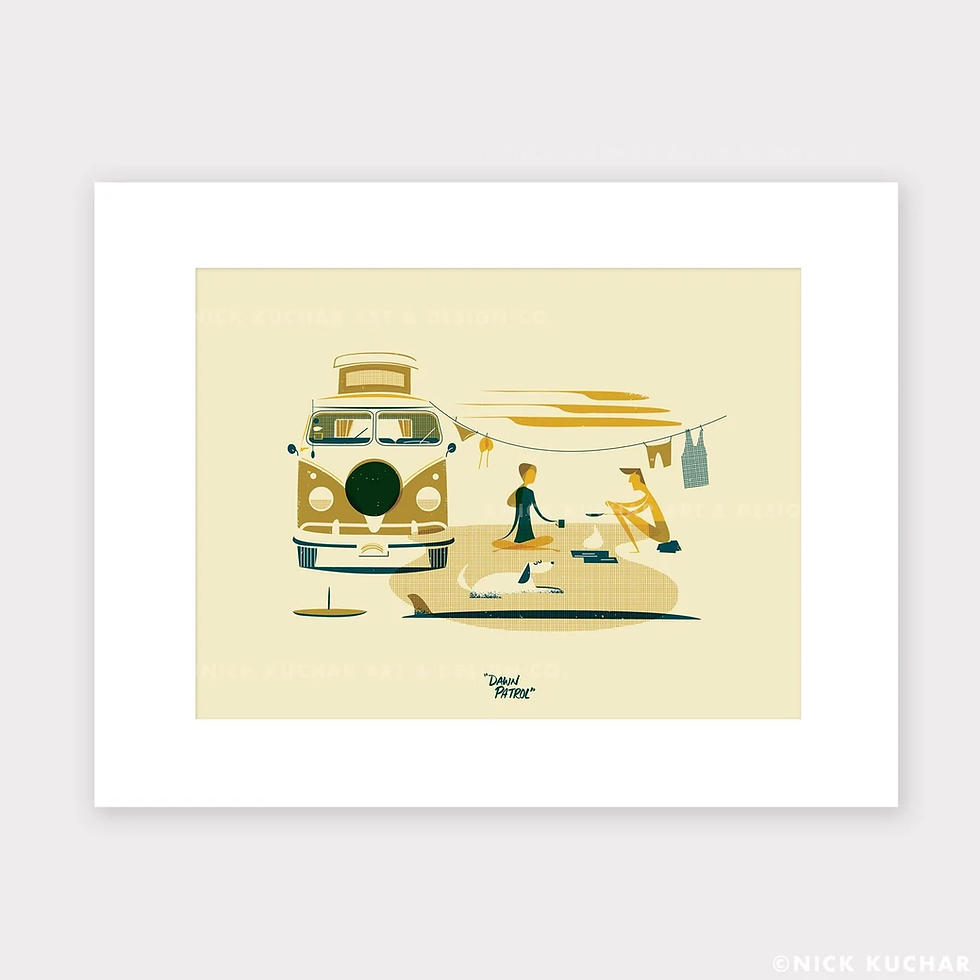
There is a particular kind of magic in the old travel posters of Hawaiʻi: a sweeping crescent of golden sand, a palm tree leaning toward turquoise water, a distant volcanic ridge dissolving into the afternoon haze. These images belong to an era when the islands were being introduced to the wider world as an extraordinary tropical destination, their landscapes transformed into invitations to adventure. For Oʻahu-based artist Nick Kuchar, this visual language would become the foundation of a distinctive artistic identity. Through carefully composed illustrations, sun-washed colors, and a reverence for the islands' natural beauty, Kuchar has helped give vintage Hawaiian travel art a contemporary life, creating works that celebrate not simply a destination, but the feeling of being there.
The origins of his style began with a familiar frustration. Kuchar's wife had grown tired of searching for artwork that genuinely captured the character of vintage Hawaiian travel posters, rather than merely imitating their appearance. The distinction was important: reproducing an old-fashioned aesthetic was one thing, but creating something that possessed the same sense of place, romance, and visual storytelling was another. What emerged from this search was an opportunity to reinterpret a beloved artistic tradition through a modern perspective. Rather than treating nostalgia as a formula, Kuchar developed an approach that could evoke the past while remaining rooted in contemporary island life. His work grew from an appreciation of the graphic simplicity, evocative landscapes, and emotional promise that made vintage travel advertising so enduring.
The golden age of Hawaiian tourism provides an essential backdrop to understanding his appeal. During the mid-twentieth century, commercial aviation and the expansion of visitor infrastructure brought the islands within reach of an increasingly international audience. Travel posters helped turn Hawaiʻi into an icon of leisure, presenting its beaches, mountains, flowers, and ocean as elements of an alluring visual dream. Their carefully arranged compositions distilled an entire landscape into a single, memorable image. Kuchar draws upon this heritage without being confined by it. His illustrations revive the period's graphic sensibility, using simplified forms, strong silhouettes, and harmonious palettes to express the islands' distinctive atmosphere. The result feels simultaneously familiar and fresh, as though a forgotten poster from another decade has been rediscovered and made relevant to the present.

Yet the achievement of Kuchar's art lies in more than its resemblance to the past. Nostalgia, in his hands, becomes a way of interpreting the present. His images often emphasize the intimate pleasures of island life: the meeting of mountains and sea, the rhythm of waves against a shoreline, the quiet beauty of a coastal road, or the lush vegetation framing a distant horizon. These are not merely picturesque backdrops. They are the ingredients of an experience that visitors hope to discover and residents recognize as part of their everyday surroundings. By distilling these scenes into bold, accessible illustrations, Kuchar participates in a broader renewal of Hawaiian-inspired design, one that embraces the visual traditions of earlier generations while allowing new artists to establish their own identities. His work demonstrates how an established aesthetic can evolve without losing its emotional resonance.
Oʻahu, with its remarkable contrasts, offers an especially rich setting for this artistic vision. From the urban energy of Honolulu to the North Shore's celebrated surf breaks, the island contains landscapes that shift dramatically across relatively short distances. The Koʻolau Mountains rise in green folds above the coast, while beaches, harbors, and winding roads provide endless possibilities for graphic interpretation. Kuchar's visual language is particularly suited to such scenery because it favors clarity over photographic detail. A mountain becomes a sequence of layered shapes; the ocean becomes a field of carefully balanced color; a palm tree becomes an elegant silhouette against the sky. This reduction is not a denial of complexity but a means of concentrating attention on what makes a place recognizable. The resulting images possess the immediacy of a travel memory, capturing the essence of a landscape rather than attempting to document every detail.
An equally important dimension of Kuchar's practice is his participation in charitable causes. His creative work has included designs for the Hawaiian Humane Society and the Surfrider Foundation Oʻahu, connecting his recognizable illustration style with organizations devoted to animal welfare and the protection of coastal environments. These collaborations offer a meaningful counterpoint to the romantic imagery associated with tourism. The landscapes that inspire visitors are living ecosystems, and the communities that care for them face responsibilities extending far beyond their appearance in a poster. Supporting animal welfare and ocean conservation helps reinforce the idea that affection for Hawaiʻi should translate into tangible concern for its inhabitants and natural resources. Art can communicate these values in ways that feel inviting rather than prescriptive, using beauty as an entry point for public engagement. Such projects also demonstrate how an artist's commercial visibility can contribute to causes that serve the islands.

For visitors exploring Oʻahu, Kuchar's work offers an alternative to the conventional souvenir. Mass-produced mementos often emphasize generic tropical imagery, designed to be instantly recognizable but disconnected from the particular places people have experienced. An illustrated print, by contrast, can preserve a more personal connection to a journey. A familiar shoreline or mountain profile may recall a morning spent beside the water, a drive across the island, or the changing colors of the sky at sunset. The work's vintage character lends it a timeless quality, allowing the memory to remain meaningful long after the holiday has ended. Its graphic simplicity also makes it adaptable to different interiors, where it can function as both decoration and a reminder of a place that left a lasting impression. For travelers seeking something with a stronger artistic identity than an ordinary souvenir, Kuchar's illustrations offer a compelling option.
Purchasing art from an island-based artist can also encourage a more considered relationship with the places people visit. A souvenir need not be an object that simply announces where someone has been; it can reflect an appreciation of local creativity and the cultural life that exists beyond the visitor experience. When choosing a work by Kuchar, travelers can look for a scene that resonates with their own memories, consider the setting in which they would display it, and explore the artist's available prints and products through his official channels. His charitable collaborations provide another reason to pay attention to the values associated with particular works, although the beneficiary and terms of any donation should be checked for the specific design. In this way, collecting art becomes an opportunity to take home something personal while recognizing the people and organizations that help sustain the islands.
Ultimately, Nick Kuchar's art occupies a compelling space between memory and modernity. It draws on the optimism of vintage travel posters without simply reproducing their vision of Hawaiʻi as an untouched paradise. Instead, it offers a contemporary interpretation of the landscapes that continue to inspire artists, residents, and travelers alike. The appeal is immediate, but its significance endures in the relationship it creates between an image and the experience behind it. For visitors to Oʻahu, a Kuchar print can serve as a small, lasting reminder of the islands; for those who live there, it can express an affection for familiar landscapes through a distinctive visual language. In reviving the romance of an earlier era, his work suggests that the most enduring travel art does more than depict a beautiful place. It preserves the feeling that made someone want to remember it.


Comments