
Rulers of the Subcontinent: The Rise, Rule, and Legacy of the Delhi Sultanate
- Aug 21, 2025
- 17 min read
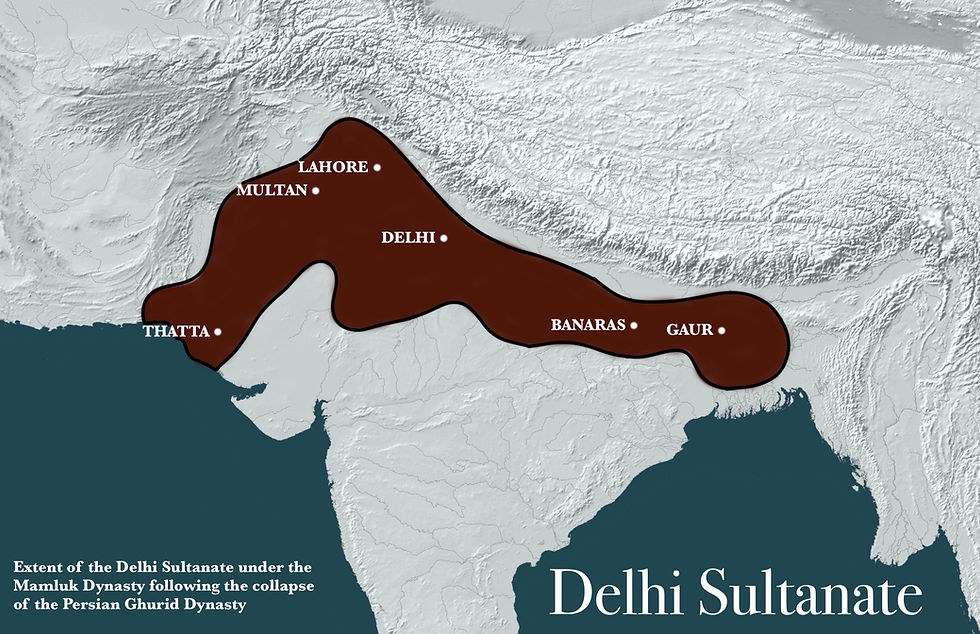
The Delhi Sultanate, a powerful empire that reigned over the Indian subcontinent from 1206 to 1526, marks a pivotal chapter in South Asian history. It began with the rise of Qutb-ud-din Aibak, the first sultan, following the defeat of the Rajput kingdoms by the Ghurid dynasty. Under Aibak’s leadership, the foundation for Muslim rule in India was laid, a reign that spanned over three centuries. This era transformed the political, cultural, and religious fabric of the subcontinent, as it bridged the Persianate world with indigenous Indian traditions. The Delhi Sultanate would eventually become a major force that reshaped India's future dynastic and cultural landscapes.
The historical significance of the Delhi Sultanate lies largely in its introduction of Islamic governance and culture to India. While Islamic rule was not new to the region, with earlier incursions by the Umayyad Caliphate, the Sultanate marked a lasting and institutionalized presence. The Sultans of Delhi established a centralized administration, with military, tax, and legal reforms that structured governance. Cities like Delhi flourished as centers of learning and culture, while the construction of monumental structures such as the Qutb Minar exemplified Islamic architectural ingenuity. The Sultanate was thus not only a political entity but a cultural engine that catalyzed the fusion of Persian and Indian traditions.
Despite being primarily military in nature, the Delhi Sultanate was characterized by an incredible level of economic and cultural exchange. Trade routes, both maritime and overland, helped foster interaction between India, Central Asia, the Middle East, and even Europe. Merchants and artisans from all corners of the Islamic world converged on Delhi, bringing with them knowledge of science, mathematics, astronomy, and art. The Sultanate’s capital became a thriving cultural hub, a beacon of scholarship and innovation. At the same time, it facilitated the spread of Islam across the northern and central regions of India, a process that would continue through the Mughal Empire and beyond.

However, the Delhi Sultanate's significance is also defined by its interactions with indigenous Indian states. The Sultanate’s military campaigns brought several regional Hindu kingdoms under its rule, including the Rajputs, the Cholas, and the Vijayanagara Empire to a degree. The Sultans' policy toward their Hindu subjects varied from tolerance to outright conflict, with some rulers, such as Alauddin Khilji and Mahmud of Ghazni, instigating campaigns that targeted Hindu temples and practices. This created a complex relationship between the Muslim rulers and their Hindu subjects, setting the stage for centuries of socio-political dynamics that would define India's trajectory.
The fall of the Delhi Sultanate in 1526, following the defeat by Babur at the Battle of Panipat, marked the end of a significant era. However, its legacy lived on through the Mughal Empire, which adopted many of the administrative, military, and cultural systems established by the Sultans. The Delhi Sultanate's influence extended beyond politics, infusing the region with a new worldview and a blend of Islamic and Indian cultural practices. The dynasty’s legacy can still be seen in India’s cultural identity today, from the dominance of Persian language in administration to the lasting impact of Indo-Islamic architecture. The Delhi Sultanate, though relatively short-lived, left an indelible mark on the course of Indian history.
The Delhi Sultanate, an empire that spanned over three centuries, dramatically altered the course of Indian history. Established in 1206 by Qutb-ud-din Aibak, it marked the beginning of Muslim rule in the Indian subcontinent, a significant departure from the region’s predominantly Hindu kingdoms. The Sultanate arose from the ashes of the Ghurid Empire, a Central Asian dynasty, following the conquest of northern India. With the rise of Aibak, a former slave-turned-general, the Sultanate became a beacon of Islamic governance in the heart of South Asia, initiating a new era in both political and cultural development.

The Delhi Sultanate was initially composed of five dynasties: the Mamluk, Khilji, Tughlaq, Sayyid, and Lodi. The Mamluk dynasty (1206–1290) laid the foundational structures of Muslim rule in India. Under Aibak and his successors, Iltutmish and Raziya Sultana, the empire expanded significantly, establishing its dominance over northern India. The Khilji dynasty (1290–1320), with its military prowess, expanded the Sultanate's reach, pushing into the Deccan and consolidating power over much of the Indian subcontinent. It was during this period that the empire saw monumental changes in administration, economy, and military strategy, including the introduction of price controls by Sultan Alauddin Khilji to curb inflation.
The Tughlaq dynasty (1320–1414) brought both stability and chaos to the Sultanate. Under Muhammad bin Tughlaq, the empire reached its greatest territorial extent, expanding into southern India. However, Muhammad’s eccentric policies, such as moving the capital from Delhi to Daulatabad and introducing a token currency system, proved disastrous, leading to widespread rebellion and economic instability. Despite these setbacks, the Tughlaq period also saw significant architectural achievements, including the construction of the Tughlaqabad Fort and the establishment of advanced agricultural and irrigation systems. The dynasty’s rule left a complex legacy of both ambition and failure.
By the time of the Sayyid and Lodi dynasties (1414–1526), the Delhi Sultanate was in decline. The empire faced internal strife, weak leadership, and external invasions from Central Asian rulers like Timur. Despite brief efforts to stabilize the realm, the Sultanate’s power waned as regional kingdoms asserted their independence. The last of the Lodi rulers, Ibrahim Lodi, faced growing discontent among his nobles, leading to his defeat at the Battle of Panipat in 1526. This battle, which marked the end of the Delhi Sultanate, opened the door for Babur, the founder of the Mughal Empire, to establish a new dynasty that would shape the subcontinent for centuries to come.

The history of the Delhi Sultanate is a tale of expansion, conflict, and cultural fusion. While the Sultanate’s political structure was often marked by military conquests and administrative reforms, its cultural and architectural contributions were profound. The blending of Persian, Turkish, and Indian influences created a unique Indo-Islamic culture, visible in the iconic structures of the period, such as the Qutb Minar and the Red Fort. Though the Delhi Sultanate ultimately succumbed to external pressures, its legacy of Islamic governance, cultural integration, and architectural grandeur continues to influence India today. Through its rise and fall, the Delhi Sultanate remains a defining chapter in South Asian history.
The Delhi Sultanate established one of the most complex and centralized political systems in medieval India. Its structure was built upon military conquest, centralized authority, and the imposition of Islamic governance over a largely Hindu population. The sultans, initially military leaders from Central Asia, wielded absolute power and often relied on a strong bureaucratic system to govern their expansive realm. The political framework of the Delhi Sultanate combined elements of Persian administrative practices with indigenous Indian traditions, creating a hybrid system that would influence subsequent empires, particularly the Mughal Empire.
At the heart of the Sultanate’s political system was the sultan, who ruled as both the political and religious leader of the state. The sultan's authority was derived from both divine right and military strength, and he was considered the guardian of Islam in the subcontinent. The sultanate’s rulers were often seen as the representatives of the Caliphate, the highest authority in Islam, which gave them a religious legitimacy. However, this legitimacy was constantly tested by the region’s diverse religious landscape, with Hindu kingdoms and local rulers frequently resisting Islamic domination. Despite this, the sultans maintained their grip on power through a combination of military might, strategic alliances, and, at times, religious tolerance or persecution, depending on the ruler.

Beneath the sultan sat a well-organized bureaucracy that helped manage the empire’s vast territories. The vizier, or prime minister, was the most significant administrative official, responsible for overseeing the day-to-day operations of the state, including tax collection, judicial matters, and military affairs. The military was also a vital component of governance, with the sultan depending on his generals to secure borders and enforce law and order within the empire. The Delhi Sultanate had a highly structured military, which included both native and Turkic soldiers, organized into elite forces such as the "Turkish cavalry" and the "Delhi infantry." Military prowess was essential, as the empire frequently faced both internal revolts and external invasions.
The sultans also implemented a sophisticated taxation system to fund the state’s military campaigns and administrative apparatus. The land revenue system, borrowed from earlier Islamic empires, was the most significant source of income. Land was assessed and taxed based on its productivity, with peasants, the backbone of the economy, paying a portion of their harvest as tribute to the state. This system was often oppressive, with the state extracting significant amounts from the peasantry, leading to periodic uprisings. Additionally, the sultanate employed a network of spies and informants to monitor the loyalty of its vast subject population, ensuring that any potential rebellion could be quickly suppressed.
In terms of political structure, the Delhi Sultanate was a highly stratified society, where power and privilege were concentrated in the hands of the sultan and his court. Regional rulers, or governors, were appointed by the sultan to manage provinces, but their power was always circumscribed by the sultan's ability to exercise direct control over their territories. The nobles, or "amirs," held significant influence and were often powerful military commanders or wealthy landowners. Yet, their power was constantly checked by the sultan, who could at any time redistribute land and military command to ensure loyalty and prevent rival factions from gaining too much autonomy. This system, while fostering centralized power, also contributed to the political instability of the Sultanate, as competing factions within the ruling elite often led to internal strife and rebellion.

The economy of the Delhi Sultanate was one of the most dynamic in medieval India, driven by agricultural production, a complex taxation system, and extensive trade networks that connected the subcontinent to the wider Islamic world. The foundation of the Sultanate’s economy was agrarian, with the majority of the population engaged in farming. Land was the principal source of wealth, and agricultural output, including rice, wheat, cotton, and sugar, fed both the population and the state’s coffers. The sultans established a highly organized revenue system, which extracted a portion of the agricultural produce as tax, helping to fund military campaigns, administrative functions, and infrastructure projects.
The Delhi Sultanate’s trade economy was bolstered by its strategic location at the crossroads of major trade routes between Central Asia, the Middle East, and Southeast Asia. Major cities like Delhi, Lahore, and Multan became bustling trade hubs, attracting merchants from across the Islamic world, as well as from China, Southeast Asia, and Europe. The Silk Road’s western leg passed through the northern reaches of India, facilitating the exchange of goods such as silk, spices, and precious metals. Additionally, Indian textiles, particularly cotton and wool, were highly sought after, as were fine crafts like carpets, jewelry, and pottery. The Sultanate’s proximity to the sea also allowed for flourishing maritime trade, especially in the ports of Gujarat and the Malabar Coast, where goods were exchanged with traders from the Arabian Peninsula, Persia, and East Africa.
Islamic merchants played a significant role in the Delhi Sultanate’s economy. Many of the sultans were themselves of Turkic or Afghan origin, and they maintained strong trade relations with Central Asian powers, such as the Khwarezmian Empire and the Ilkhanate in Persia. These connections were not only commercial but also cultural and intellectual, as Islamic scholars and artisans were often brought to Delhi, where they contributed to the Sultanate’s burgeoning architectural and scientific advancements. Moreover, the Sultanate’s influence spread as far as the Arabian Peninsula and East Africa, where Indian goods such as spices and textiles were in high demand. The Delhi Sultanate's trade links helped cement India’s position as a key player in the global economy of the medieval period.

The currency system under the Delhi Sultanate also reflected the growing sophistication of its economy. The sultans introduced standardized coinage, including the silver tanka and copper jital, which facilitated trade both within the empire and with foreign nations. This uniformity in currency allowed merchants to conduct business across vast distances with greater ease, and it symbolized the Sultanate's centralized control over economic activity. The state also promoted the use of paper money, a rare practice in the medieval world, although it was met with mixed success under rulers like Muhammad bin Tughlaq, whose ill-fated attempts at introducing a token currency resulted in widespread economic disruption.
Despite its prosperity, the economy of the Delhi Sultanate was not without challenges. Frequent military campaigns, combined with the taxing of peasants, led to periodic social unrest. The agricultural economy, heavily reliant on land revenue, was often vulnerable to fluctuations due to weather conditions, crop failures, or invasions. Additionally, the Sultanate's extensive reliance on foreign trade exposed it to the risks of global instability, including the Mongol invasions of the 13th century, which disrupted trade routes. Yet, despite these challenges, the Delhi Sultanate’s economy remained a powerful force, linking India to a vast global network and laying the groundwork for the later economic expansion under the Mughal Empire.
The Delhi Sultanate was a melting pot of diverse peoples, cultures, and religions, creating a vibrant and complex demographic landscape. While the majority of the population was Hindu, the Sultanate was ruled by a Muslim elite, predominantly of Turkic, Afghan, and Persian origin. This confluence of ethnic and religious groups resulted in a rich cultural amalgamation, with Persian, Central Asian, and Indian traditions merging to shape the subcontinent's social and cultural identity. The arrival of the Sultans introduced Islam as a dominant force, but Hinduism, Buddhism, and Jainism continued to thrive in the lower echelons of society. The Sultanate's demographic fabric was further diversified by the influx of traders, scholars, soldiers, and artisans from various parts of the Islamic world, contributing to an environment of cosmopolitanism in cities like Delhi, Multan, and Lahore.

Culturally, the Delhi Sultanate left a lasting imprint on South Asia, particularly in the fields of language, literature, art, and architecture. Persian became the official language of administration and culture, replacing Sanskrit, and this shift had profound effects on literature, poetry, and intellectual life. The Sultanate saw the rise of notable Persian poets and scholars, many of whom flourished in the royal courts. The fusion of Persian and Indian cultural elements led to the development of new artistic traditions, including miniature painting and Indo-Islamic music, which blended Persian classical influences with indigenous styles. The Sultanate also fostered the growth of Islamic learning, with many madrasas and libraries established, contributing to the intellectual and spiritual life of the empire.
One of the most enduring legacies of the Delhi Sultanate is its distinctive architecture, which blended Islamic and Indian styles in ways that would influence the region for centuries. The Sultanate's architectural legacy is most apparent in the grand mosques, tombs, and forts that were constructed during this period. The Qutb Minar, built by Qutb-ud-din Aibak, is one of the earliest and most iconic examples of Indo-Islamic architecture, combining Persian calligraphy and motifs with Indian architectural forms. The design of the Qutb Minar reflects the Sultanate's desire to assert Islamic authority while integrating the region's pre-existing architectural heritage. Over time, the Sultanate's architecture evolved, with each successive dynasty adding its unique touches to the architectural landscape.
Tughlaq architecture, particularly during the reign of Muhammad bin Tughlaq and his successor, Firoz Shah Tughlaq, introduced bold new innovations and an expansion of monumental building projects. Muhammad bin Tughlaq, known for his ambitious and often controversial policies, commissioned a number of architectural works that were both impressive and visionary. His plan to relocate the capital from Delhi to Daulatabad, although ultimately unsuccessful, led to the construction of new fortifications, including the city walls and gates of Daulatabad. Firoz Shah Tughlaq, in particular, is credited with creating several significant structures, including the Tughlaqabad Fort, an imposing fortress that exemplified the dynasty’s military might. The fort’s massive stone walls, large gates, and defensive features marked a departure from the earlier, more ornamental designs of the Sultanate, emphasizing utility and strength over aesthetic beauty.
The Tughlaq period also saw the development of a distinct architectural style that combined Indian construction techniques with Persian and Turkish influences. The use of durable materials like sandstone and the introduction of intricate geometric patterns and calligraphy are hallmarks of Tughlaq architecture. The Tughlaqabad Fort, with its massive bastions and strategic location, is a prime example of this fusion. Another notable structure from the period is the tomb of Firoz Shah Tughlaq, which features a large, domed structure surrounded by gardens, an innovation that would later be expanded upon by the Mughals. This blending of functional military architecture with elements of Islamic beauty and Indian craftsmanship laid the foundation for the development of later architectural styles in the subcontinent, particularly during the Mughal Empire.
The Delhi Sultanate was shaped by a series of remarkable rulers, each contributing to the empire’s growth, stability, and cultural transformation. The dynasty began with Qutb-ud-din Aibak, a former slave who became the first Sultan of Delhi. Aibak’s reign (1206–1210) set the foundation for Muslim rule in northern India after his military victories over the Rajputs. His architectural legacy, most notably the Qutb Minar, symbolizes the fusion of Persian and Indian styles that would define the Sultanate’s architectural evolution. Although his reign was brief, Aibak’s establishment of Delhi as a political center paved the way for subsequent rulers to expand the empire.
Following Aibak, Iltutmish (1211–1236) ascended to the throne and consolidated the Sultanate’s power. A capable military leader, Iltutmish expanded the empire and repelled Mongol invasions, securing northern India for the Delhi Sultanate. His reign was marked by administrative reforms that stabilized the empire. He introduced a regularized currency system and strengthened the Sultanate’s bureaucracy, providing a foundation for future rulers to govern effectively. Iltutmish also laid the groundwork for the Sultanate’s cultural fusion, ensuring that Persian became the official language of administration, a shift that would influence the region’s literary and artistic development.

One of the most unique rulers in Delhi Sultanate history was Raziyyat-ud-Dunya wa Ud-Din, the daughter of Iltutmish. Raziyyat ascended the throne in 1236, becoming the first female ruler of Delhi. Her reign was marked by progressive policies and efforts to implement justice across the Sultanate. Raziyyat was a competent leader, known for her attempts to curtail the power of the nobility and establish direct control over the administration. She even led military campaigns, demonstrating her prowess in governance and defense. However, her rule faced resistance from the male-dominated nobility, who deposed her in 1240. Despite her short reign, Raziyyat’s legacy as a female ruler in a patriarchal society remains significant.
Alauddin Khilji (1296–1316) is often regarded as one of the most effective rulers of the Delhi Sultanate. His reign was marked by military conquest and economic reforms that expanded the empire and stabilized the economy. Khilji’s military campaigns against the Rajputs and his expansion into the Deccan solidified Delhi’s control over much of the subcontinent. He also implemented market regulations and price controls, which helped prevent inflation and made food accessible to the common people. Known for his authoritarian rule, Khilji centralized power, ensuring that both the military and the nobility remained loyal to him.
Muhammad bin Tughlaq (1325–1351), another influential but controversial ruler, is remembered for his ambitious but often failed policies. Tughlaq sought to expand the empire’s reach and instituted bold reforms, including the relocation of the capital to Daulatabad and the introduction of token currency. These measures, however, were poorly executed, leading to economic chaos and discontent. Despite his failures, Tughlaq’s reign saw significant architectural achievements, including the construction of the Tughlaqabad Fort. His rule exemplified the challenges faced by rulers in balancing visionary reforms with the practicalities of governance, leaving a complex legacy that would influence the future of the Sultanate.

The downfall of the Delhi Sultanate was a complex process shaped by a combination of internal instability, external invasions, and the changing dynamics of political power. While the Sultanate reached its height under rulers like Alauddin Khilji and Muhammad bin Tughlaq, it eventually faced insurmountable challenges that led to its decline. The erosion of centralized authority, exacerbated by frequent leadership changes and factional struggles, weakened the Sultanate’s ability to maintain control over its vast territories, setting the stage for its eventual collapse.
One of the key factors in the decline of the Delhi Sultanate was the weakening of central authority, especially following the death of Muhammad bin Tughlaq in 1351. His successors, such as Firoz Shah Tughlaq, lacked the political acumen and military prowess to maintain control over the empire. The Tughlaq dynasty saw a rapid decline in power, as the nobility became more autonomous and rebellious provinces started asserting their independence. These internal fractures were further compounded by administrative inefficiency and a lack of effective leadership, which led to widespread discontent among both the nobility and the common people.
The Sultanate also faced significant external threats during its decline. The Mongol invasions in the 13th and 14th centuries had already inflicted considerable damage on the empire, and by the 15th century, the Delhi Sultanate was increasingly vulnerable to external forces. The rise of powerful regional kingdoms, such as the Mewar and the Vijayanagara Empire, further eroded the Sultanate’s control over large swaths of land. These regional kingdoms, which had once been subordinate, now began to challenge Delhi’s authority, often with military might and political maneuvering, further destabilizing the empire.

The final blow to the Delhi Sultanate came with the invasion of Babur, the founder of the Mughal Empire, in 1526. The Lodi dynasty, the last ruling family of the Sultanate, was embroiled in internal power struggles, which left the empire weak and divided. Ibrahim Lodi, the last Sultan, faced widespread discontent from his nobles and military leaders, who were disillusioned with his rule. In 1526, Babur’s forces decisively defeated Ibrahim Lodi at the Battle of Panipat, effectively ending the Delhi Sultanate and marking the beginning of the Mughal era in India. This defeat symbolized the collapse of an empire that had once dominated the subcontinent.
The fall of the Delhi Sultanate had lasting repercussions on the Indian subcontinent. It marked the end of centuries of Muslim rule in northern India and the beginning of a new era under the Mughals, who would go on to build one of the most powerful empires in South Asian history. Despite the Sultanate’s eventual collapse, its legacy lived on through the cultural, architectural, and administrative innovations that it left behind. The decline of the Delhi Sultanate, while a moment of political failure, set the stage for the transformation of India into a more diverse and complex political landscape that would shape the future of the region for centuries to come.
The Delhi Sultanate, despite its eventual downfall in 1526, left a profound and lasting legacy on the Indian subcontinent. Its influence can be seen in many aspects of South Asian culture, politics, and architecture, shaping the region for centuries to come. The Sultanate’s rule established a new era of Islamic governance in India, which persisted long after its demise, particularly under the Mughal Empire. This period marked the beginning of significant cultural and religious integration between Islamic and indigenous Indian traditions, laying the groundwork for a unique Indo-Islamic identity.

One of the most enduring aspects of the Delhi Sultanate was its architectural legacy. The period saw the rise of Indo-Islamic architecture, which blended Persian, Turkish, and Indian styles. Iconic structures such as the Qutb Minar, built during the early years of the Sultanate, remain enduring symbols of Islamic rule in India. The architectural innovations of the Sultanate, particularly the use of intricate geometric patterns, large domes, and pointed arches, were adopted and expanded upon by subsequent rulers, notably the Mughals. The Sultanate’s construction of grand mosques, forts, and tombs not only changed the skyline of Delhi but also set the stage for later architectural masterpieces such as the Taj Mahal.
The Delhi Sultanate also left an indelible mark on the cultural and intellectual life of India. Persian became the language of the royal court, administration, and culture, replacing Sanskrit as the dominant language of governance. This linguistic shift paved the way for the flourishing of Persian literature, poetry, and philosophy, which blended with local traditions. The period saw the emergence of a rich Indo-Persian cultural fusion, particularly in the fields of music, painting, and art. The Sultanate also promoted the growth of Islamic learning, with many madrasas and libraries being established, which continued to influence Indian education for generations.
Politically, the Delhi Sultanate’s legacy is evident in the administrative systems that it put in place. The Sultanate introduced centralized governance, a feature that was later adopted by the Mughals and other empires in India. The Sultanate's military organization and its complex tax system helped ensure the empire's stability for several centuries. Additionally, the Sultanate played a key role in the spread of Islam throughout northern and central India. Although the rulers often faced resistance from Hindu kingdoms, their reign marked the beginning of the significant integration of Islam into Indian society, a process that would continue under later Muslim rulers.
The Delhi Sultanate’s impact on Indian society was not just limited to politics and culture; it also had lasting effects on the region’s economy. The Sultanate’s vast trade networks connected India with Central Asia, the Middle East, and Southeast Asia, facilitating the exchange of goods, ideas, and technologies. The currency system introduced during the Sultanate helped streamline trade across the empire, and its expansion of agricultural production supported a growing urban economy. The Sultanate’s rule also brought important technological and scientific knowledge from the Islamic world, including advancements in astronomy, mathematics, and medicine, which were integrated into Indian society and had long-lasting effects on the region’s development.


Comments