
Little Tokyo on the Yukon: The Story of Frank Yasuda
Long before stern-wheelers churned its currents and prospectors carved rough trails along its banks, the Yukon River moved in vast, unhurried silence. Rising in the mountains of British Columbia and winding more than 1,900 miles to the Bering Sea, it braided through spruce forests and tundra, sustaining Athabascan communities whose lives followed the rhythms of salmon runs and caribou migrations. Birchbark canoes skimmed its surface, guided by knowledge accumulated over generations. The river was highway, pantry, and spiritual corridor—its seasonal floods and freeze-ups marking time more reliably than any clock.

That equilibrium fractured in 1896 with the Klondike Gold Rush. News of gold transformed the Yukon into a corridor of feverish ambition. Within two years, tens of thousands of stampeders surged north, hauling supplies over mountain passes and launching makeshift boats into the river’s swift spring melt. Boomtowns flared into existence almost overnight. With them came disease, displacement, and violence. Measles, influenza, and tuberculosis tore through Native Alaskan villages with devastating speed, decimating populations already strained by disrupted hunting grounds and collapsing trade networks. The river that had long sustained Indigenous life became, for a time, a conduit of upheaval.
Into this turbulent frontier arrived Frank Yasuda, a Japanese adventurer born in the late nineteenth century who had first gone to sea as a youth. Drawn by the same currents of opportunity that carried so many north, he reached Alaska by way of maritime work, eventually making his way inland along the Yukon. Unlike many who sought only gold, Yasuda stayed. He learned local languages, adopted subsistence lifeways, and married into an Athabascan family. In a region wary of outsiders, he built trust through endurance and respect, navigating not only the river’s bends but also the cultural crossings of a changing North.
Yasuda later helped establish the village of Beaver, Alaska, along the Yukon’s broad sweep. There, his life became legend—an immigrant who embraced the rigors of Arctic winters and the intimacy of river travel. In Japan, tales of his exploits filtered back across the Pacific, romanticizing the Yukon as a proving ground of resilience and masculine adventure. For some Japanese men, especially in the twentieth century’s early decades, canoeing the Yukon became a symbolic pilgrimage, echoing Yasuda’s journey into self-reliance at the edge of the world. The river, once a gold-rush artery, evolved again—this time into a distant horizon of aspiration, shaped in part by one man who followed its current to a new home.
Long before headlines trumpeted gold in the Klondike, the Yukon River coursed through the North in a silence broken only by wind, water, and wingbeats. Rising in the coastal mountains of British Columbia, it carved a sweeping arc across interior Alaska, braiding into gravel bars and oxbows before emptying into the Bering Sea. In summer, sunlight lingered past midnight, gilding the river’s broad surface in copper and rose. In winter, it locked beneath thick ice, a white highway stretching beyond the horizon.

For the Indigenous peoples of the region—Gwich’in, Hän, Koyukon, Deg Hit’an, and others—the Yukon was not wilderness but homeland. Its currents formed a living map, each bend and tributary named and storied. Seasonal fish camps lined its banks, where families gathered to harvest the great salmon runs that pulsed upriver each year from the sea. Smokehouses perfumed the air with alder and willow as strips of salmon dried for the long cold months. Knowledge of eddies, sandbars, and shifting channels passed from elders to youth as carefully as songs and stories.
The river valley was a corridor of life. Moose browsed in willow thickets along sloughs, while black and grizzly bears prowled berry-rich hillsides. In autumn, caribou herds crossed tributaries in restless migrations, their hooves drumming against gravel bars. Bald eagles perched high in spruce, watching for flashes of silver in the current. The Yukon’s floodplain nourished dense stands of white spruce, birch, and poplar, replenished each spring when ice breakup sent shards grinding downstream in a thunderous procession.
Travel along the Yukon required intimate skill. Birchbark and spruce-root canoes, light yet resilient, skimmed across calm stretches and threaded through swift channels. In winter, dog teams traced routes over frozen surfaces, connecting scattered settlements in a network of trade and kinship that extended far beyond the river itself. Obsidian, copper, furs, and stories moved along these pathways. Far from isolated, the river linked interior peoples to coastal communities and to distant partners across the subarctic.
Before the gold seekers arrived with steam engines and stampeders’ dreams, the Yukon followed an older rhythm. Its wealth was measured not in nuggets but in salmon runs, in the return of geese each spring, in children learning the names of currents. Time was marked by freeze-up and breakup, by the first ice groaning along the banks, by the river’s release into open water. In those centuries before the rush, the Yukon was both constant and alive—a vast, breathing artery through the northern world.
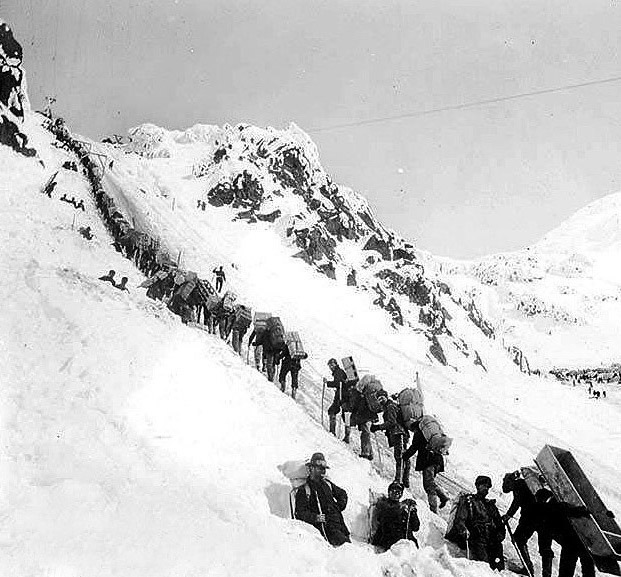
The discovery of gold along a tributary of the Yukon in 1896 ruptured this enduring rhythm. Word traveled swiftly by ship and telegraph, and by the following year tens of thousands of stampeders were pushing northward through mountain passes and downriver in hastily built boats. Boomtowns such as Dawson City erupted almost overnight, their muddy streets jammed with newcomers unprepared for the Arctic’s demands. The Yukon River, once guided by seasonal migrations and subsistence cycles, became a crowded artery of ambition.
With the influx came epidemics that Indigenous communities had little immunity against. Measles, influenza, smallpox, and tuberculosis spread along the same waterways that had long connected villages in trade and kinship. In settlements where generations had thrived on salmon harvests and caribou hunts, illness swept through entire families in a single winter. Oral histories recall the silence that followed—camps abandoned, smokehouses cold. In some regions of Alaska and the Yukon Territory, Native populations declined sharply within just a few years, their demographic losses compounding earlier waves of disease introduced during the fur trade era.
Displacement accompanied disease. Prospectors staked claims along riverbanks and tributaries that Indigenous families depended on for fishing and seasonal camps. Game grew scarcer near mining centers as demand for meat intensified. Forests were cut for fuel and construction, altering habitats and accelerating erosion along fragile banks. Traditional trade routes shifted or collapsed under the weight of new economic systems that prioritized gold over reciprocity. For many Native families, survival meant navigating an imposed cash economy while trying to maintain cultural lifeways rooted in subsistence and stewardship.
Missionaries and government agents followed close behind miners, establishing schools and churches that sought to reshape Indigenous identities. Children were often sent to mission schools where Native languages and spiritual practices were discouraged or forbidden. The authority structures of clans and extended families were strained by outside legal systems that neither recognized nor respected traditional governance. What had been a river of stories became, in official maps and documents, a corridor of extraction and regulation.
Yet resilience persisted along the Yukon’s sweeping bends. Communities adapted where they could—combining wage labor with seasonal harvests, preserving oral histories, and sustaining ceremonies despite mounting pressures. Elders carried forward ecological knowledge that had guided river life for centuries, even as steamboats churned past fish camps. The gold rush left indelible scars: population loss, cultural disruption, and altered landscapes. But it did not erase the deep ties between the river and its first peoples. Beneath the legacy of boomtowns and abandoned dredges, the Yukon continued to flow, bearing witness to both devastation and endurance in the North.

Thousands of miles from the Yukon’s sweeping bends, in a coastal town in Japan, Frank Yasuda was born into a family whose name carried the quiet authority of generations of physicians. For decades, Yasudas had practiced medicine in the traditional manner, tending neighbors through epidemics and lean harvests, blending herbal knowledge with emerging modern techniques. In a society balancing ancient customs and rapid industrial change, the family’s calling offered both respect and responsibility. As a boy, Frank grew up among medical texts, instruments polished to a dull shine, and conversations about duty to community.

But the Meiji era’s transformation of Japan brought volatility as well as opportunity. Economic shifts, changing regulations, and mounting financial obligations began to erode the family’s stability. Investments faltered; debts accumulated. The prestige of a medical lineage proved fragile against the pressures of modernization. For young Frank, the atmosphere of disciplined learning was increasingly shadowed by anxiety. Household discussions turned from patients and remedies to creditors and repayments. The weight of expectation—of restoring the family’s fortunes—settled on his shoulders even before he reached adulthood.
Rather than follow the established path into medicine, Yasuda chose a more uncertain horizon. Stories of opportunity abroad circulated in port cities, carried by sailors and merchants who spoke of California’s expanding industries and distant frontiers. Mitsubishi, then building its commercial reach across the Pacific, offered apprenticeships to ambitious young men willing to leave home. For Yasuda, the prospect represented both escape and obligation: a chance to forge income in a new land and, perhaps, to repay the debts that had humbled his household.
Accepting the apprenticeship meant stepping into a different world. In California, he would encounter bustling docks, immigrant enclaves, and a society marked by both promise and prejudice. The apprenticeship was practical and demanding, rooted in maritime trade and the logistics of a rapidly globalizing economy. It required discipline akin to medical training but directed toward commerce and navigation. For a young man raised in a tradition of healing, the work was a pivot—from tending bodies to mastering ships, cargo, and currents.
Yet the decision also reflected a deeper restlessness. The same currents that would one day carry him toward Alaska were already shaping his course. Leaving Japan was not simply an economic calculation; it was an act of reinvention. Yasuda departed with the memory of ancestral duty and the sting of financial collapse, carrying both across the Pacific. In choosing apprenticeship over inheritance, he stepped into the uncertain space between tradition and frontier—a space that would ultimately lead him far beyond California, toward the vast river valleys of the North.

When Frank Yasuda arrived in California, he entered a society restless with growth and sharpened by exclusion. The docks where he apprenticed under Mitsubishi’s commercial network hummed with the clang of rigging and the shouted orders of foremen, yet beneath the industry lay suspicion. The Chinese Exclusion Act of 1882 had hardened attitudes toward Asian immigrants, casting them as perpetual outsiders. Though Japanese laborers were not yet barred by law, hostility often blurred distinctions. Newspapers trafficked in caricature; labor unions stoked fears of competition. For young men like Yasuda, ambition moved through a landscape edged with prejudice.
Within immigrant neighborhoods along the waterfront, community offered refuge. Boardinghouses smelled of miso and sea salt; letters from home were read aloud by lantern light. Apprenticeship demanded long hours tallying cargo, maintaining vessels, and learning the intricacies of Pacific trade. Yasuda absorbed the rhythms of tides and timetables, the discipline of accounts and manifests. Yet he also learned the quieter skills of survival—when to lower his gaze, when to answer insults with silence, when to rely on fellow migrants for solidarity in a city that regarded them with wary eyes.
Opportunities remained constrained. Anti-Asian sentiment flared periodically into violence, and employment could evaporate with a rumor or a downturn. Laws and informal agreements limited land ownership and civic participation. For a young man raised in a lineage of physicians, the promise of advancement narrowed to a thin corridor. The apprenticeship provided wages and experience, but not belonging. California’s horizons, once imagined as expansive, began to feel bounded by invisible lines drawn in policy and prejudice.
Then, in 1897, headlines erupted with news from the North: gold discovered along the Klondike. Photographs of miners clutching sacks of nuggets circulated in shop windows. Ships outfitted for Alaska crowded San Francisco Bay. The fever for fortune cut across class and nationality, offering a seductive narrative of reinvention. In the goldfields, one might be judged by endurance rather than ancestry, by the strength to haul supplies over mountain passes or steer a boat through ice-choked rivers. For Yasuda, the call of the Yukon promised not only wealth but a different measure of worth.

He left the Mitsubishi apprenticeship with little certainty beyond that promise. Boarding a vessel bound for Alaska, he joined the tide of stampeders chasing rumors of sudden prosperity. The journey north was grueling, marked by cold spray and crowded decks, but it carried a fragile hope: that in the vastness of the subarctic frontier, identity might be reshaped. California had taught him resilience amid exclusion. Alaska, he believed, might offer something rarer—a chance to define himself along a river where fortunes and futures were still unwritten.
When Frank Yasuda reached Alaska, he did not follow the main artery of stampeders toward Dawson. Instead, his path bent farther north, toward the wind-scoured edge of the continent. Barrow—today known as Utqiaġvik—stood at the meeting point of tundra and Arctic Ocean, a place of bowhead whales, drifting pack ice, and months of darkness. Gold fever had drawn many to the Yukon basin, but Yasuda sought something less tangible than nuggets. He arrived on the North Slope intent on remaking himself in a land where survival depended less on rumor and more on reciprocity.
The Inupiat communities he encountered were navigating their own upheavals. Decades of commercial whaling had already altered subsistence cycles, introducing trade goods alongside disease and dependency. Epidemics and shifting economies had strained populations; elders worried about the erosion of knowledge carried in stories, skin boats, and seasonal migrations. The Arctic was changing under external pressures, and the future felt uncertain. Into this fragile landscape stepped a newcomer from across the Pacific, himself shaped by displacement and ambition.
Yasuda’s early months were marked by apprenticeship of a different kind. He learned to read the sea ice—its pressure ridges and leads of open water—and to travel by dog team across a horizon that erased all but the most practiced sense of direction. He observed whale hunts launched in umiaks stitched from seal skins, and shared in the distribution of maktak, the prized whale skin and blubber that sustained communities through winter. Trust formed slowly, measured not in words but in endurance: hauling, mending, listening.
Among those who came to know him was a young Inupiat woman named Nevelo. Their meeting, recalled in fragments through oral histories, unfolded not as a dramatic encounter but through the ordinary intimacies of camp life—shared labor, shared meals, shared winters. In a region where kinship networks structured survival, marriage bound Yasuda to more than a partner; it wove him into a web of relationships that defined belonging. Through Nevelo’s family, he gained deeper fluency in language and custom, and with it a sense of rootedness he had not found in California’s restless ports.
Yasuda’s intention had been to find a new life, and in Barrow he began to build one intertwined with the fortunes of the Inupiat. At a time when populations wavered under the weight of disease and economic change, he contributed labor and advocacy, navigating between cultures with the pragmatism of a mariner. The Arctic did not promise easy wealth. It offered instead a harder currency: mutual reliance against cold and uncertainty. In that stark northern light, Yasuda’s search for reinvention merged with a community’s struggle to endure.

Restlessness eventually stirred again in Frank Yasuda. The Arctic coast had given him belonging, yet rumors of interior strikes drifted north along trading routes and whaling ships. Gold had been found not only in the Klondike but along tributaries of the great Yukon. Determined to see the interior for himself, Yasuda set out overland from Barrow, leaving the Arctic Ocean behind for the vast sweep of tundra and boreal forest. The journey south demanded stamina and trust in Indigenous guides who knew the land’s hidden passes.
Traveling by dog team and on foot, he crossed treeless expanses where winter light shimmered across wind-packed snow. Rivers became roads in the cold months, their frozen surfaces offering the most reliable routes through otherwise trackless country. As spring neared, the landscape shifted—spruce forests thickened along river valleys, and the air softened with the promise of breakup. The expedition traced ancient trade corridors linking the North Slope to the Yukon basin, pathways long used by Inupiat and Athabascan peoples long before prospectors mapped them.
Reaching the Yukon River, Yasuda encountered a waterway transformed by the gold rush yet still immense and indifferent to human ambition. He prospected along gravel bars and tributaries, learning to read the subtle signs of placer deposits in the river’s bends. Accounts describe him working with patient focus, panning sediments in icy water, testing each shovelful against hope. In time, he located enough gold to secure a modest claim—wealth not measured in bonanza headlines but in the means to anchor himself more permanently to the interior.
Rather than chase larger strikes elsewhere, Yasuda chose settlement. Along a broad stretch of the Yukon, he helped establish what would become the village of Beaver, Alaska. The site lay within the homelands of Gwich’in and Koyukon Athabascan families, who fished the river’s salmon runs and hunted the surrounding forest. Beaver grew not as a boomtown of tents and saloons but as a small, enduring community shaped by subsistence and trade. Yasuda’s fluency across cultures positioned him as mediator and participant, equally at ease with mining tools and fish nets.

In founding Beaver, Yasuda’s journey came full circle—from a physician’s son in Japan to an apprentice on California’s docks, from Arctic husband to Yukon settler. The river that had carried waves of fortune seekers now bore a quieter story: of a man who followed its course not only for gold but for belonging. Beaver endured beyond the fevered years, a testament to adaptation along the Yukon’s banks. In its cabins and fish camps, the currents of migration, resilience, and reinvention converged in one unlikely life.
In Beaver, life settled into the measured cadence of the Yukon’s seasons. Spring breakup arrived with a thunder of grinding ice, followed by the urgent labor of setting fish wheels and mending nets before the salmon surged upriver. Summers stretched long and luminous; children chased one another along sandy banks while smokehouses breathed alder-scented air into the forest. Frank Yasuda worked beside his wife Nevelo and their growing family, cutting wood, tending gardens, and panning when river levels allowed. The settlement drew other families—Athabascan relatives, traders, a handful of prospectors weary of boomtown volatility—each seeking steadier ground than the goldfields’ gamble.
Beaver never swelled into a city. It remained intimate, its cabins clustered above the floodplain, its trails threading through spruce and birch. Yasuda’s experience across cultures made him a bridge in practical matters: translating during trade negotiations, guiding newcomers through winter travel, advocating for supplies when river steamers stopped. He understood that survival hinged less on individual fortune than on shared effort. In winter, when temperatures plunged and daylight narrowed to a blue hush, households pooled labor and stories, reinforcing bonds that insulated against isolation.
Word of Yasuda’s northern life traveled far beyond the Yukon’s bends. Traders carried anecdotes south; visiting journalists, hungry for tales of unlikely frontiersmen, sketched his story in dispatches that crossed the Pacific. Japanese newspapers, attuned to narratives of perseverance abroad, published accounts of a countryman who had carved a home at the edge of the Arctic. Photographs—grainy images of fur-lined parkas, sled dogs, and river ice—circulated in port cities. In an era when Japan balanced tradition with modern ambition, Yasuda’s story embodied both filial resolve and daring self-invention.

The reports framed Alaska not merely as a land of gold but as a proving ground of character. For some Japanese men, especially sailors and students in coastal prefectures, the Yukon became a distant horizon charged with possibility. Canoe journeys along its broad reaches promised endurance, solitude, and communion with a formidable landscape. Yasuda’s path—apprentice, migrant, settler—suggested that identity could be reshaped through hardship and respect for place. His marriage and community ties underscored a different kind of success, rooted in belonging rather than bonanza.
Back in Beaver, such renown mattered little against the immediacy of weather and work. Yet the ripple of his story endured, carried by print and rumor into imaginations far from the boreal forest. Along the Yukon, children of mixed heritage learned river lore from elders; across the Pacific, young men traced the river’s line on maps. Between them flowed the same current—a belief that at the confluence of cultures and wilderness, a life could be made anew.
Today the Yukon River still runs nearly 2,000 miles from mountain headwaters to the Bering Sea, but its banks carry satellite dishes alongside smokehouses. Snowmachines rest where dog teams once waited; aluminum boats hum past bends where birchbark canoes once slipped silently through eddies. Yet the river’s pulse remains seasonal and sovereign. Spring breakup still thunders downstream in a chaos of ice, and summer salmon still flash silver beneath the midnight sun.
Native Alaskan communities—Gwich’in, Koyukon, Deg Hit’an, Hän, and others—continue to anchor life along its course. In villages reachable only by boat or small plane, families set fish wheels, cut dry fish, and pass on language and land knowledge to children who learn both algebra and ancestral place names. Cultural revitalization efforts strengthen traditions strained by generations of upheaval. Elders teach how to read currents and weather, how to listen for the subtle shift in wind that signals change. The Yukon remains pantry, pathway, and teacher.
Into this living landscape threads the quiet legacy of Frank Yasuda. He was never a titan of industry or a headline magnate of the gold rush. His name rarely appears in textbooks, and his claim to fame rests less on wealth than on endurance. Yet his life—bridging Japan, California, the Arctic coast, and the Yukon interior—became a story carried across oceans. In Japan, accounts of a countryman who built a home along one of the world’s great northern rivers stirred imaginations. For decades, adventurers and paddlers traced his route in spirit if not in exact geography.
Canoes now glide down the Yukon each summer, guided by maps, GPS units, and outfitter advice. Some travelers come for solitude, others for history, still others for the test of distance against their own resolve. Among them are Japanese paddlers who speak of Yasuda not as a conqueror but as a compass—a reminder that reinvention can be found in cold water and long horizons. Along the Yukon, where Indigenous presence stretches back millennia, his story remains a small but persistent current. It suggests that even lives that seem minor in the grand ledger of history can ripple outward, shaping journeys far beyond their source.



Comments