
Elusive Carnivore: Borneo's Ghost Cat
On the edge of a vast green world, where the trees grow so tall they’re greeted by the clouds and the air hums, filled with the songs of insects. There exists an island that’s stitched together by winding rivers and shadowy mountains. This island is home to one of the oldest rainforests on Earth, this island is commonly referred to as Borneo. A place where its plant life has been growing for millions of years and where new discoveries still hide quietly beneath its leaves. The air here is thick with humidity, the ground is soft with fallen plants, and the sounds of its wildlife never fully fade away.

Deep inside this forest lives one of the most mysterious meat-eating maples even found. Scientists sometimes refer to it as a mystery carnivore because so little is understood about how it lives, what it prefers to eat, and how many even exist in the wild. Even the most experienced researchers can spend years studying the rainforest without coming across one. Yet the animal is very real, it moves silently through tangled branches and steps so carefully across the mossy ground.
This elusive creature is called the Borenean bay cat.
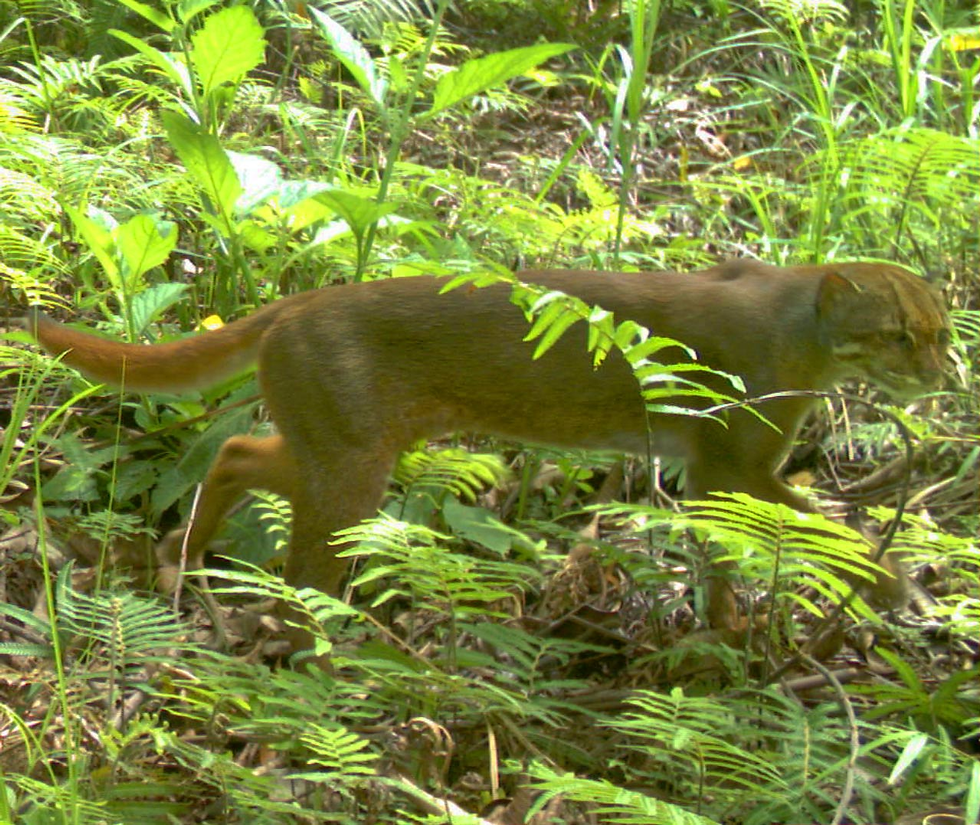
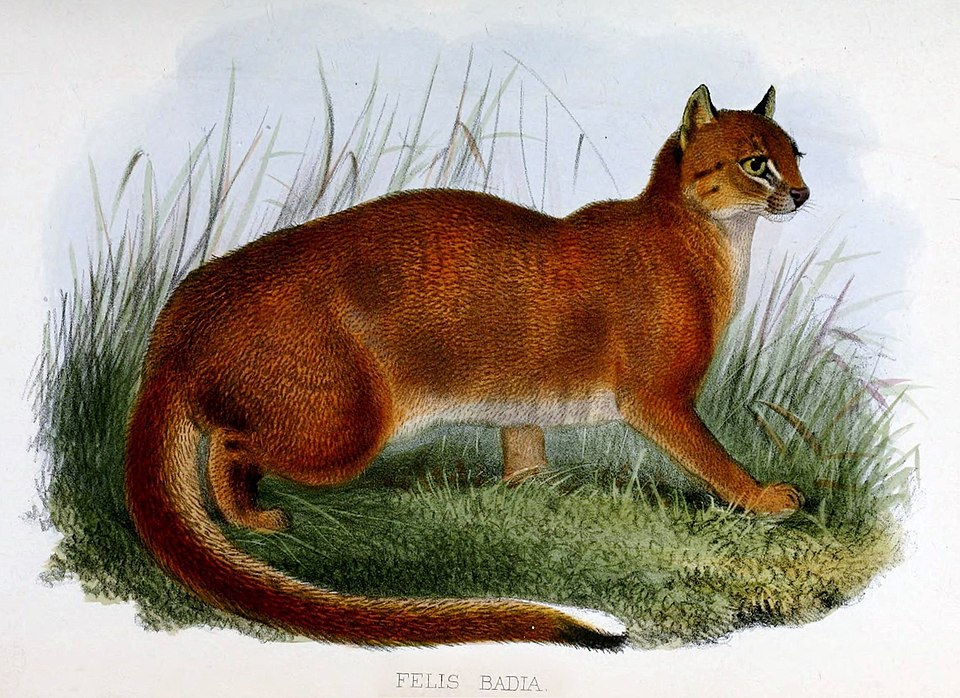
At first glance, the bay cat might look very similar to a familiar house cat, but with a closer look it reveals something wilder. Its body is built strong and athletic, good for climbing, leaping and slipping between roots. Its fur shines in shades of reddish brown, sometimes glowing copper when sunlight peaks through the canopy. The tail is long and helps with balance, especially when traveling along narrow branches high above the forest floor. Its rounded ears swivel constantly, catching even the faintest rustle.
It has wide eyes to help it see in dim conditions where shadows stretch long and golden light barely reaches the ground floor of the forest. Carnivore refers to a meat eater, and unlike other wild cats, the bay cat depends on hunting to survive. The rainforest is full of potential meals, ranging from small mammals and birds to reptiles and insects. Every hunt requires patience. A successful hunter in these parts of the forest must listen carefully, stay hidden and move at the exact right moment. Too soon and the prey will escape. Too late, and the opportunity disappears.
Yet, despite being a predator, the bay cat is rarely noticed. Its secretive nature has puzzled scientists for more than a century. It’s like it was made for stealth.
A long time ago, knowledge of the animal came mostly from preserved specimens and scattered reports. Some naturalists examined skins and bones, trying to imagine how the animal once lived. Others recorded brief descriptions from people who believed they had caught a glimpse of a reddish cat crossing a path or vanishing into thick vegetation. Because sightings were so uncommon, the animal seemed almost legendary, almost as though it belonged halfway between reality and imagination.
Now imagine shrinking down to the size of a leaf and riding on the back of a rainforest breeze. You float past towering trees that look like skyscrapers and land softly on a mossy branch. From this tiny explorer’s view, the forest feels enormous. Every root is a winding road. Every puddle is a shimmering lake. Somewhere nearby, the Bornean bay cat is on the move. You do not hear loud footsteps. You do not hear roaring. What you notice instead is stillness. Birds pause for just a second. Leaves shift in a careful way. The forest seems to hold its breath. Then you see it.
A flash of reddish fur glides between tree trunks. It moves like a shadow painted with golden colors. Its body stays low, smooth, and focused. This is not a chase across open fields. This is a quiet game of hide-and-seek played in green tunnels of vines and branches.

The bay cat’s paws press gently against the ground. If you looked closely, you would see how perfectly designed they are for stealth. Soft pads act like built-in mufflers. Sharp claws stay tucked away until needed, then extend in an instant for climbing or gripping prey. Suddenly, the cat leaps onto a fallen log. From there, it climbs a leaning tree. Higher and higher it goes, balancing with its long tail. From this treetop pathway, the forest floor looks far below. Sunlight filters through leaves, turning the fur on its back into glowing copper. Up here, the rainforest is like a secret city in the sky. Squirrels dash along branches. Birds flutter between fruit clusters. Insects shimmer like tiny flying jewels. The bay cat pauses, watching everything with patient golden eyes.
It is not always about speed. Sometimes being a great hunter means being the best observer. Hours might pass with nothing but careful watching and listening. The cat’s ears swivel independently, picking up distant rustles. Its whiskers twitch, sensing air movement. Even the smallest clue matters. When the moment is right, action happens in a blink. A spring forward. A quick grab. Then stillness again.
But the rainforest is not only about hunting. It is also about exploration. The bay cat may cross shallow streams by stepping on smooth stones. It may squeeze through thick bamboo clusters. It may rest beneath giant leaves that shelter it from tropical rainstorms. Picture a sudden downpour. Rain pounds on the canopy like thousands of tiny drums. Water races along branches and drips to the ground. The bay cat finds a dry space beneath tangled roots and waits patiently while the storm passes. When the rain slows, mist rises like magic smoke, and the forest smells fresh and new.
If you were an explorer searching for this mysterious carnivore, you would need a huge level of patience. You might check camera traps filled with hundreds of pictures of leaves and insects before finally spotting one amazing image of reddish fur. That single photo would feel like a breakthrough.
Tracking the bay cat is like solving a giant scavenger hunt. Instead of collecting objects, scientists collect clues. A footprint in soft mud. A scratch mark on bark. A blurry photograph taken at night. Each clue adds another piece to the puzzle.
And here is something exciting, there are still questions waiting to be answered. Does the bay cat have a favorite climbing tree? How far can it leap between branches? How many kittens does it raise at a time? These unanswered questions mean the adventure is not finished. Right now, there are still scientists who cannot answer basic questions about this cat. That is unusual in a time when so much of the world has been mapped and studied. The Bornean bay cat is a reminder that even today, there are gaps in our knowledge.
It does not need to be large or famous to matter. Its importance comes from its role in the rainforest and from the fact that it exists only in one place on Earth. When a species is that limited, understanding it becomes urgent.
Tonight, while most people are asleep, the bay cat will continue moving through the forest as it always has, hunting, resting, avoiding danger. Whether humans are watching or not, its life goes on. The real question is whether the forest around it will remain healthy enough for that to continue far into the future.
The answer is not only about protecting one rare cat. It is about protecting the whole forest that the cat depends on. Think of the rainforest like a giant team. The trees, insects, birds, and small mammals all have different jobs. If one part of the team disappears, the others can struggle. The bay cat needs healthy prey to hunt. Those prey animals need plants to eat. The plants need
good soil, clean water, and the right amount of rain. Everything is connected, like links in a chain.

When people cut down too many trees or build roads through the forest, it changes the team. Some animals lose hiding places. Others have trouble finding food. Even small changes can make a big difference for a quiet hunter like the bay cat.
In a place like that, even a small cat can seem to disappear like a shadow. Sounds echo strangely, and light slips through in thin beams. For an animal built for quiet movement, the rainforest is the perfect hiding place. To really understand why this cat is so hard to spot, it helps to picture what its home is like.
The rainforest itself explains part of the mystery. Unlike open grasslands where animals can be spotted from far away, tropical forests are like layered worlds. The tallest trees form a roof over the forest called the canopy. Beneath it grows a second layer of smaller trees, often followed by shrubs, vines, and ferns. The forest floor is crowded with roots and fallen branches. Visibility is often limited to just a few steps ahead.
For an animal that prefers privacy, this environment is perfect.
Many wild cats are solitary, meaning they live alone rather than in groups. Solitary animals avoid unnecessary attention and compete less for food. They communicate through things like scent markings, subtle sounds, and body language that humans may never notice. Living alone also means fewer chances for observers to witness their daily routines.
Imagine trying to locate a single quiet animal in a forest that stretches for thousands of miles. The challenge would feel like searching for one leaf in a sea of green.
However, technology has helped reveal some pieces of the puzzle. Motion-activated cameras placed along animal trails have captured photographs whenever something passes. These cameras must be left in the forest for weeks or months, enduring everything from rainstorms and humidity to curious wildlife. Most images show the common forest residents, but occasionally a remarkable photograph appears of a sleek reddish cat stepping through the frame. Each image confirms that the bay cat is still lurking, yet each one also reminds researchers how rarely the animal is encountered.
Understanding why rare animals matter begins with understanding ecosystems. An ecosystem is a community of living things that interact with one another and with their environment. Plants capture sunlight and create energy. Herbivores eat plants. Carnivores help keep herbivore populations balanced. Decomposers return nutrients to the soil. Every species plays a role, even those that remain hidden most of the time.
If a predator disappears, that balance can shift. Certain prey species may grow too numerous, which can affect vegetation and other animals. Protecting predators often helps protect entire habitats.
The bay cat likely contributes to this balance in ways scientists are still learning about. Rainforests are among the most diverse environments on the planet. Some scientists estimate that a single acre can hold hundreds of tree species. Bright mushrooms push through damp soil. Butterflies flash colors like living confetti. Frogs cling to leaves that collect tiny pools of water. Overhead, branches create natural highways for animals that rarely touch the ground. Survival here requires special adaptations. Strong limbs help with climbing. Sensitive hearing detects danger. Camouflage allows animals to blend into bark, leaves, or shadows. The bay cat’s reddish coat may help it disappear among fallen leaves and filtered light, making it difficult for both prey and observers to spot.
But, a lot about the bay cat's behavior still remains a mystery. Researchers are still investigating whether it prefers daytime or nighttime activity, how large its territory might be, and how often it reproduces. Even estimating population size is challenging when encounters are so rare.

Mystery, however, is not a sign of failure in science. Instead, it shows that the natural world is vast and that discovery is an ongoing process. Many species were once considered nearly mythical until careful observation proved otherwise.
Curiosity drives this work forward. Every photograph, footprint, or trace adds another piece to a growing picture.
Beyond the scientific questions lies a bigger concern, habitat change. Rainforests face pressure from logging, agriculture, mining, and development. When forests shrink or become fragmented, animals lose the continuous space they need to hunt, migrate, and reproduce. Picture a giant puzzle being broken into smaller pieces. Some animals cannot cross open areas safely, so populations become isolated. Over time, isolation can make survival harder for the inhabitants.
Conservation is the effort to protect species and the places they live. Protected reserves, sustainable land management, and community partnerships all contribute to this goal. Conservation is not only about saving a single animal, it is about preserving the intricate web of life that supports countless species, including us humans.
Healthy forests help regulate climate, store carbon, and influence rainfall patterns. They provide resources for local communities and shelter for wildlife that’s found nowhere else. Among the wildlife that depends on this shelter, the Bornean bay cat stands out as one of the most fascinating. Even though it is rarely seen, scientists have gathered clues that help paint a clearer picture of what makes this carnivore so special.
The bay cat belongs to the same broad family as lions, tigers, and house cats, but it is found only on Borneo. That makes it endemic, which means it lives nowhere else on Earth. If the forests of Borneo disappear, the bay cat has no backup home. This alone makes it incredibly important.
Its body is compact but powerful. Strong shoulders help it climb trees with ease. Flexible joints allow it to twist mid-leap. Its paws are wide enough to grip bark and soft enough underneath to move almost silently across the forest floor. When it walks, it places its back paw almost exactly where the front paw stepped, reducing noise and leaving a neat line of tracks. Its fur is one of its most striking features. The deep reddish-brown color blends beautifully with fallen leaves, tree trunks, and filtered sunlight. In certain lighting, the coat can appear almost golden. The underparts are usually lighter, creating subtle contrast. Some individuals have faint markings on their faces that give them a serious, focused expression.
The tail is long and thick, helping with balance when climbing or making sharp turns. Imagine running across a narrow beam high above the ground. The tail works like a counterweight, keeping the cat steady as it moves through branches that sway in the wind. The bay cat’s senses are finely tuned. Its hearing can detect tiny movements in the undergrowth. Its eyesight is adapted for low light, which may help it hunt during dawn, dusk, or nighttime hours. Its whiskers are not just decorative, they act like sensitive measuring tools, helping the cat judge whether it can fit through tight spaces or detect changes in air currents nearby.

As a carnivore, the bay cat likely eats a variety of prey. Scientists believe it may hunt rodents, birds, reptiles, and possibly even insects when available. In a rainforest, meals can be
unpredictable. Flexibility is an advantage. A hunter that can adjust its diet has a better chance of surviving seasonal changes.

Hunting in dense forest requires strategy. The bay cat cannot rely on long chases like a cheetah on open plains. Instead, it has to use stealth. It may crouch low, body pressed close to the ground, muscles coiled like springs. Each step forward is slow and controlled. When the moment is right, a quick burst of speed ends the pursuit.
Climbing skills add another layer to its hunting ability. Prey in the rainforest often escapes upward, so being able to scale trunks and move along branches expands the cat’s options. High in the canopy, movement can be just as complex as on the ground. Branches vary in thickness, and gaps between trees require careful judgment before leaping.
Although the bay cat is a predator, it must also be cautious. Larger carnivores share the forest, and avoiding confrontation is usually safer than fighting. Remaining hidden reduces risk. Its quiet nature may be one reason it has remained so mysterious for so long. Scientists continue to study its relatives to better understand it. The bay cat is closely related to the Asian golden cat and the marbled cat, both of which share certain physical traits. Comparing these species helps researchers guess how the bay cat might behave, though direct observation is always best.
Reproduction remains one of the least understood aspects of its life. Like other small wild cats, it likely gives birth to a small number of kittens at a time. These young would be born blind and helpless, relying entirely on their parents. Over weeks and months, they would learn to stalk, pounce, climb, and survive. Training would be gradual and careful, because mistakes in the wild can be costly.
Kittens probably practice hunting by chasing insects or wrestling with siblings before attempting larger prey. Playing with young predators is actually important learning. It strengthens muscles, sharpens reflexes, and builds coordination.
As the young mature, they would eventually leave to establish their own territories. Territory size depends on food availability. In rich habitats, animals may not need to travel far. In less abundant areas, they might roam greater distances.
Another fascinating aspect of the bay cat is how little we know about its vocalizations. Many wild cats communicate with growls, chirps, or hisses, but recordings of the bay cat are extremely rare. It may use subtle sounds or rely more heavily on scent marking to communicate with others of its species.
Scent marking can involve rubbing against trees, scratching bark, or leaving traces of scent that other cats can detect. These invisible messages may signal territory boundaries or readiness to mate.
The idea that such a skilled predator can remain largely unseen makes it especially intriguing. In an age where satellites map the planet and drones explore remote regions, the bay cat reminds us that mystery still exists.
Researchers studying the species must combine patience with creativity. They analyze camera trap data, examine tracks, and sometimes collect environmental DNA from soil or water samples to detect presence. Environmental DNA is genetic material left behind by animals, such as tiny skin cells or hair. By testing samples, scientists can confirm whether a species has recently passed through an area without ever seeing it directly.
This detective-style science adds excitement to conservation work. Each clue is valuable. Each confirmed sighting helps refine maps of where the cat lives.

The history of the Bornean bay cat is almost as mysterious as the animal itself. Unlike lions or tigers, which have been written about for thousands of years, the bay cat stayed hidden in dense rainforest while the rest of the world changed around it. Its story stretches back long before humans ever set foot on Borneo.
Millions of years ago, when continents shifted and sea levels rose and fell, islands in Southeast Asia were sometimes connected by land bridges. During colder ice ages, lower sea levels exposed stretches of land that allowed animals to move between regions. Over time, as the climate warmed and waters rose again, some animals became isolated on islands. Isolation can shape evolution in powerful ways. Species adapt to their specific environments, slowly becoming unique.
Scientists believe the ancestors of the Bornean bay cat reached Borneo long ago and then became separated from their mainland relatives. Over thousands and thousands of years, they adapted to island life. Their bodies, fur color, and behaviors likely shifted in response to the thick rainforest habitat and available prey. Eventually, they became a distinct species found nowhere else on Earth.
The first scientific description of the bay cat dates back to the 1800s. European naturalists exploring Southeast Asia collected specimens of unfamiliar animals and sent them to museums for study. When researchers examined the reddish cat from Borneo, they realized it was something different from other known species. It was formally described and given a scientific name, but after that early discovery, information became scarce.
For decades, the animal seemed to vanish into the forest again.
Throughout the late 19th and much of the 20th century, only a handful of specimens were recorded. Scientists debated how rare the cat truly was. Some wondered whether it had always been uncommon or whether human activity had reduced its numbers. Others speculated that it might simply be exceptionally shy and good at avoiding detection.
The problem was not a lack of interest. It was the difficulty of studying wildlife in dense tropical rainforest. Thick vegetation, heavy rainfall, insects, and rugged terrain made research challenging. Unlike open savannas where animals can be observed from vehicles, Borneo’s forests required long hikes through muddy trails and limited visibility.
Because sightings were so rare, the bay cat gained a reputation as one of the least-known wild cats in the world.
Everything began to change in the late 20th century with improvements in wildlife research technology. Camera traps revolutionized the way scientists study elusive animals. Instead of waiting silently for hours hoping for a glimpse, researchers could place cameras along animal paths and return later to check the images. In the 1990s and early 2000s, camera trap photographs finally captured clear images of living bay cats in the wild. These photographs were exciting because they confirmed the species still survived and provided new insight into its appearance and behavior. Each image added another small chapter to the cat’s modern history.
Around the same time, conservation awareness in Borneo increased. Logging and land conversion for agriculture had expanded during the 20th century. Large areas of forest were cleared, which fragmented habitats. Scientists realized that if rare species like the bay cat were to survive, protected areas would be essential. National parks and wildlife reserves became critical strongholds. Research programs expanded, and international conservation organizations began collaborating with local communities and governments to safeguard biodiversity. Genetic studies also played a role in understanding the bay cat’s past.
By comparing DNA from the bay cat to related species such as the Asian golden cat and the marbled cat, scientists confirmed that the bay cat represents a unique evolutionary branch. Its genetic distinctiveness highlights how long it has been separated and evolving independently on Borneo. This evolutionary history makes it especially valuable from a scientific perspective. Every species carries genetic information shaped by millions of years of adaptation. Losing a species means losing that irreplaceable history.
The bay cat’s story is also connected to the broader history of Borneo itself. The island has long been home to Indigenous communities who have lived alongside wildlife for generations. Traditional knowledge about the forest sometimes included awareness of rare animals, even if
they were seldom seen. While written scientific records are relatively recent, human familiarity with the forest stretches far deeper into time.
In modern years, the bay cat has become a symbol of rainforest mystery and conservation importance. Wildlife documentaries occasionally mention it as one of the rarest cats on Earth. Conservation campaigns highlight it to show how much remains unknown about tropical ecosystems. Despite this growing recognition, it remains one of the least photographed and least studied members of the cat family.
Today, researchers continue building on its historical record. Long-term monitoring projects aim to understand population trends. Habitat mapping helps identify key areas for protection. Scientists hope that as methods improve, the bay cat’s story will become clearer. Yet part of its history will always remain unwritten. The centuries before scientific documentation are mostly silent. No one recorded how many roamed ancient forests or how their territories shifted over time. Those chapters exist only in the living descendants that still walk the rainforest today.
In that way, the bay cat is both ancient and modern. Its lineage reaches back through geological ages, while its survival now depends on present-day conservation choices. Its history teaches an important lesson: discovery does not always happen all at once. Sometimes knowledge grows slowly, piece by piece, across generations of researchers. What began as a single preserved specimen in the 1800s has become an ongoing scientific journey. And that journey continues, as the forests of Borneo still hold more pages of the bay cat’s history waiting to be uncovered.



Comments